
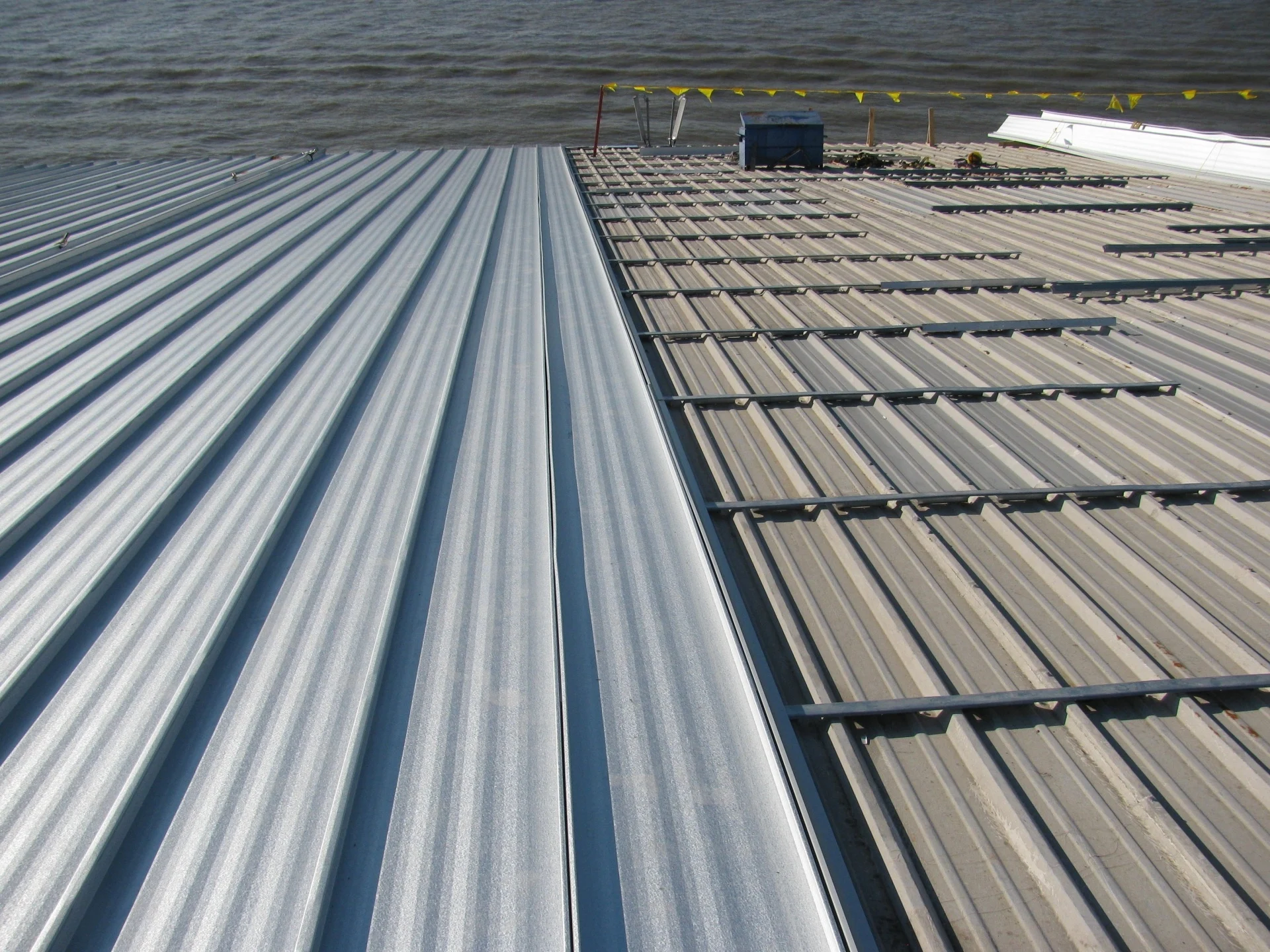
TPO (thermoplastic polyolefin) is the workhorse single-ply membrane for San Antonio commercial flat roofs. It reflects radiant heat - critical in a city where July surface temperatures on dark membranes regularly exceed 165°F - welds cleanly with hot-air seam tools, and carries 20-year manufacturer NDL warranty paths from every major manufacturer. The Alamo Dome on HemisFair Park, the AT&T Center, and most of the large-footprint institutional buildings built in San Antonio run TPO.
We install TPO mechanically attached, fully adhered, or ballasted depending on building use, wind exposure, and the manufacturer's design package. Most San Antonio commercial work is mechanically attached on tapered polyiso over metal or concrete deck - the configuration that handles the city's wind exposure and the thermal cycling between extreme summer heat and the rare hard freeze that Uri demonstrated in February 2021.
TPO Thickness - 60-mil vs. 80-mil
60-mil TPO is the volume-grade specification for San Antonio commercial buildings. Adequate for most warehouse, retail, and office buildings with normal rooftop traffic and standard mechanical equipment. Carries a 20-year manufacturer NDL warranty from every major manufacturer and is the baseline for most USAA campus buildings on Babcock Road and the HEB distribution facilities on the South Side.
80-mil TPO costs more per square foot installed but extends warranty life to 25 years from some manufacturers, handles higher mechanical-traffic environments, and provides better puncture resistance. We specify 80-mil for buildings with heavy rooftop equipment requiring frequent maintenance access - hospitals, data centers, manufacturing facilities - and for owners who want the lower lifecycle cost of a longer-warranted system.
Both thicknesses are available in white (highest reflectivity), light gray, and tan. San Antonio's heat load makes white the default recommendation for most buildings. A white 60-mil TPO roof reflects roughly 80% of solar radiation and can reduce rooftop surface temperature by 50 to 70°F compared to a dark BUR or modified bitumen surface.
Attachment Methods
Mechanically attached: Most common in San Antonio. Membrane fastened with screws and plates through the membrane and insulation into the deck on a pattern designed against the building's wind-uplift requirement. Fast and cost-effective. Our fastener pattern is designed using ASCE 7-22 wind pressure calculations for the building's location, height, and exposure category - not a generic grid.
Fully adhered: Membrane bonded to the substrate with a TPO-compatible adhesive. Used when the project needs the cleanest aesthetic, when the deck cannot tolerate additional penetrations, or when wind-uplift requirements exceed what mechanical attachment can deliver. More expensive and slower to install, but provides a cleaner finished surface and performs better in cyclonic uplift events.
Recover (over existing membrane): When existing insulation is dry and the deck is sound, TPO can be installed over an existing single-ply membrane. This avoids tear-off cost and landfill disposal. We verify the recover path with moisture cores - a recover over wet insulation traps moisture and voids the new warranty.
Common TPO Failures in San Antonio and How We Prevent Them
Seam failure from heat: San Antonio's extreme summer temperatures stress TPO seams. Cold welds - seams that were not hot enough during installation - fail within 2 to 5 years. Our welders run test welds at the start of each production day to verify the gun temperature and roller pressure produce a full-fusion weld. We probe-test every linear foot of seam with a round-tipped probe before closeout.
Flashing detail failure at penetrations: Penetrations, parapets, drains, and curb flashings are where most TPO roofs leak. We follow the manufacturer's published flashing details exactly - custom fabricated details that deviate from the manufacturer's specification fail warranty inspection. Every flashing detail is photographed against the manufacturer's spec sheet at closeout.
UV and heat degradation from inadequate thickness: Older TPO formulations from the early 2000s degraded under San Antonio's UV intensity faster than expected. Current 60-mil and 80-mil formulations from major manufacturers are tested to withstand the UV load in ASTM G154 and G155 accelerated weathering tests. We document the manufacturer, formulation, and lot number on every project so the owner knows exactly where their membrane falls on the lifecycle curve.
Ponding water: San Antonio's limestone-influenced drainage patterns and low-slope roof geometries create ponding on many flat roofs. Standing water accelerates TPO membrane degradation and stresses seams. Our scope work identifies ponding areas during inspection and designs tapered insulation packages that eliminate ponding - or flags it explicitly as a condition-of-scope if eliminating it is not feasible within the project budget.
Frequently asked questions
Which TPO manufacturer do you install?
We install systems from GAF, Carlisle, Johns Manville, Sika Sarnafil, and Versico. We are manufacturer-agnostic - the right manufacturer for your building depends on warranty terms, available thicknesses, the manufacturer's San Antonio field representative coverage, and what your owner's roof asset standard specifies. We will recommend based on those criteria and will document the basis of our recommendation.
How does TPO perform in San Antonio's heat?
Modern 60-mil TPO formulations are warranted for 20 years and typically perform 25 to 30 years in San Antonio conditions with proper maintenance and annual seam inspection. The reflective surface reduces substrate temperature by 50 to 70°F compared to dark roofs, which is significant in a city where ambient temps regularly exceed 100°F from late June through mid-September.
Can TPO handle the occasional San Antonio freeze event?
Modern TPO remains flexible at temperatures down to -40°F, so it handles San Antonio's occasional freeze events without the membrane cracking. The February 2021 Uri event caused more damage to flashing details and seam welds on poorly installed or aged roofs than to the membrane itself - which is why installation quality and seam testing matter as much as membrane selection.
Scoping a TPO project for a San Antonio building?
We will walk the roof, document existing conditions, and produce a TPO scope - replacement or recover - with manufacturer warranty path and installed-cost estimate.
Request a Roof Scope