
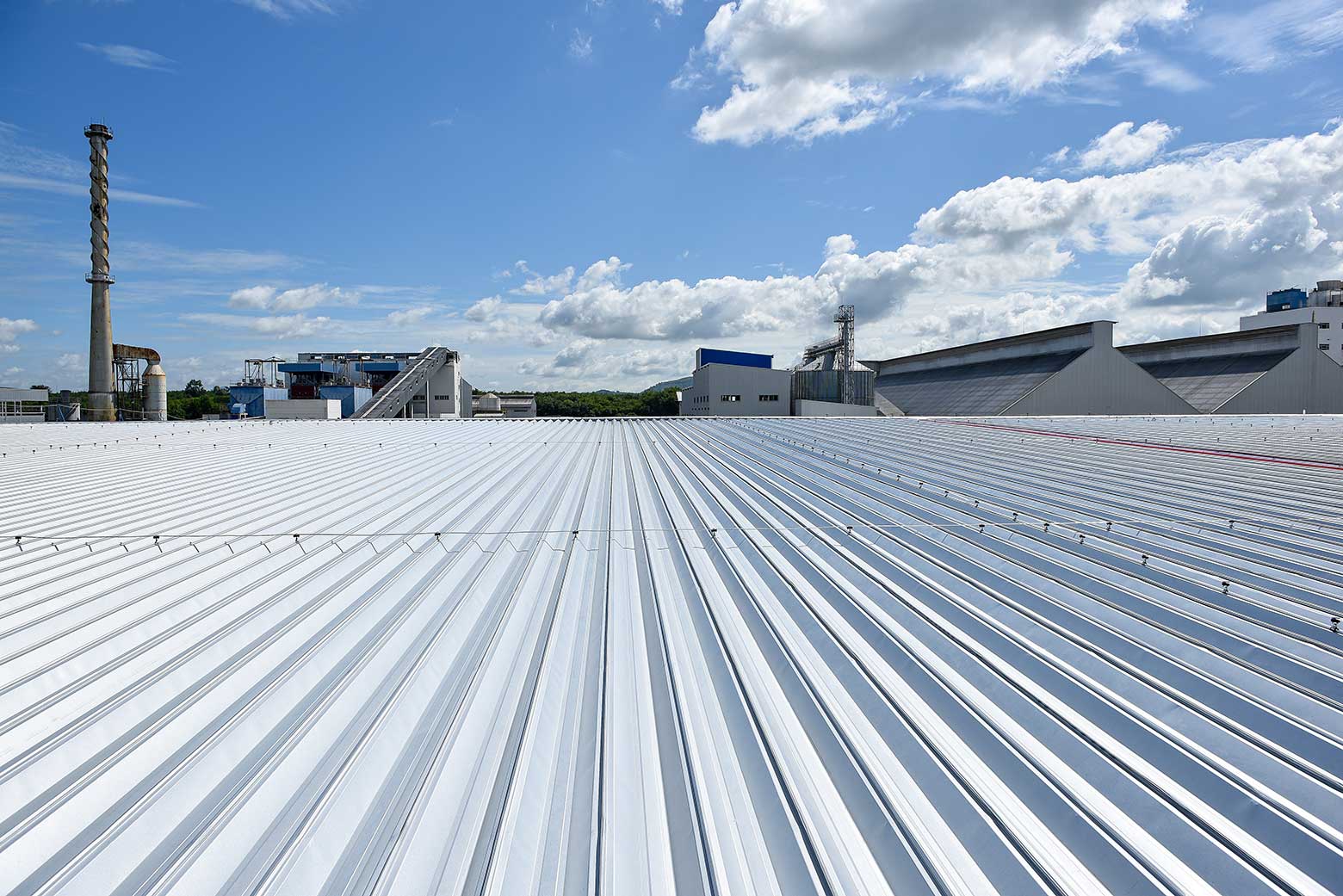
Standing Seam Metal Roofing
Roofing Services

Standing Seam Metal Roofing

Architectural standing seam metal roofing for San Antonio commercial buildings - Galvalume and Kynar-painted systems for Pearl District redevelopment, religious buildings, schools, and long-capital-horizon commercial owners.

Scope Type
Roofing Services
Location
San Antonio, TX
Status
Scheduling Roof Walks
Focus
Repair history, moisture risk, roof access, system condition, and replacement timing.

Standing seam metal roofing has been showing up on San Antonio commercial projects in three distinct contexts. The first is the Pearl District redevelopment north of downtown - adaptive reuse and new infill construction where exposed standing seam panel lines read as intentional architectural character rather than utilitarian cladding. The second is institutional construction: independent school district campuses on the Northside and Northeast ISDs, church and religious facility construction throughout the city's suburban corridors, and civic buildings where a 40-year design life is the expectation, not a stretch goal. The third is commercial owners with long hold horizons who have done the lifecycle cost math and concluded that paying more per square foot upfront for a system they will not reroof for four decades is the correct capital decision.

We install standing seam in all three contexts. Every project is scoped against the building's slope, structural capacity, thermal movement range, and manufacturer warranty requirements - because standing seam fails at the details and the clips, not the panels, and those components require precise coordination with the manufacturer's published design package.

San Antonio's climate creates specific standing seam performance considerations that buildings in cooler markets do not face. The thermal range between a July rooftop surface temperature above 160°F and a hard freeze event - the February 2021 Uri freeze produced single-digit temperatures at San Antonio International Airport - puts meaningful thermal stress on panel runs. Clip systems and panel expansion allowances designed for a more moderate climate underperform here. We design to the actual San Antonio thermal range, not a generic Gulf Coast assumption.

Galvalume vs. Kynar-Painted Finish

Galvalume - a zinc-aluminum alloy coating on the steel substrate - is the base durability standard for commercial standing seam. It carries a 40-year substrate warranty from major manufacturers including Drexel Metals, McElroy, and MBCI, all of which ship to San Antonio through regional distributors serving the Texas Hill Country and South Texas markets. If the building does not need a color statement, Galvalume is the honest specification: maximum longevity, lowest price per square, zero repainting requirement over the system's life. Several of the Pearl District's industrial redevelopment buildings have used Galvalume for exactly this reason - the raw metal finish reads as intentionally modern in that context.

Kynar 500 or 70%-PVDF painted finishes add color and architectural flexibility. Religious facilities and school campuses in San Antonio typically specify Kynar because the color choice is part of the building's identity - the Northside ISD campus buildings along Bandera Road and Loop 281 North corridor near the Encino Park and Stone Oak communities run a range of architectural colors that a Galvalume finish cannot deliver. Kynar carries a 40-year substrate warranty and a 30-year color/chalk/fade warranty from most manufacturers.

San Antonio's intense UV index - the city receives significantly more direct solar radiation annually than San Antonio or Houston because of its more southerly latitude and the lower cloud cover that comes with being on the drier side of the Balcones Escarpment - puts meaningful UV stress on both finish types. Galvalume handles this well; Kynar requires the 70%-PVDF formulation for sustained color integrity. We specify 70%-PVDF as the minimum for any San Antonio standing seam project with a painted finish. Lower-grade fluoropolymer coatings that perform adequately in northern climates chalk and fade faster in this UV environment.

Snap-Lock vs. Mechanical Seam

Snap-lock panels interlock at the seam without a mechanical seaming tool. They install faster, carry lower labor cost per square, and are appropriate for slopes above 3:12 where gravity drainage ensures the seam is not under hydrostatic pressure. Most of the standing seam we install on sloped institutional buildings - school gymnasium annexes, church nave roofs, covered pavilion structures at Brooks City Base mixed-use - is snap-lock because those slopes are adequate for free drainage.

Mechanical seam panels are crimped to 180° or 360° with a powered seaming tool after installation. The double-lock seam performs reliably at slopes as low as 1:12 - the low-slope territory where most commercial flat-to-low-slope standing seam retrofit applications live. Any San Antonio commercial standing seam project on a building with a slope below 3:12 requires mechanical seam. Snap-lock below 3:12 on a San Antonio commercial roof is a failure mode, not a specification, and we will not install it regardless of cost pressure from the project budget.

Thermal movement on a 200-foot commercial panel run in San Antonio spans roughly 1.5 inches across the annual temperature range - from peak summer surface temperatures to the occasional hard freeze. The concealed clip system that holds each panel to the substrate while allowing longitudinal movement is where standing seam failures originate when the clip is undersized, over-fastened, or specified for a narrower thermal range than the building actually experiences. We design the clip pattern to the manufacturer's expansion allowance for the San Antonio thermal environment, not a default clip spacing from the manufacturer's general installation guide.

Substrate, Structural, and Closeout

Standing seam installs on structural metal deck, steel purlins, or solid substrate (plywood or OSB) depending on panel span, building structural design, and the manufacturer's load tables. San Antonio commercial buildings with metal deck typically run 1.5-inch or 3-inch corrugated deck - adequate for standing seam with 12-inch to 18-inch clip spacing on standard-span bays. Older institutional buildings, particularly the mid-century school and church construction throughout the city, may have concrete or wood deck that requires a different substrate approach and structural verification before standing seam can be specified.

Insulation under standing seam on San Antonio commercial buildings is typically rigid polyiso over deck with a cover board, designed to current IECC energy code minimums for Climate Zone 2 (R-25 minimum for low-slope commercial). Metal roofing assemblies with open framing require thermal bridging calculations - the metal clips and purlins create conductive pathways through the insulation that the simple R-value calculation does not capture. We account for thermal bridging in our energy code compliance documentation, which is required by the City of San Antonio Development Services Department for permit approval.

At closeout we deliver the manufacturer's warranty document, the 40-year substrate warranty, the thermal movement calculation record keyed to the San Antonio temperature range, the clip and fastener schedule keyed to the structural drawing, and the zone photo log. This is the permanent record the building's next owner or contractor needs to understand what system they inherited and what it was designed to do.

Frequently asked questions

Can standing seam be installed on a building that currently has a flat roof?

Yes. A standing seam retrofit over an existing flat roof uses a sub-framing system - Z-purlins or hat channels - installed over the existing roof surface to create positive slope and provide attachment points for the standing seam panels. The existing flat membrane stays in place and acts as an air and vapor retarder. This approach is used on San Antonio commercial warehouse and institutional buildings where adding slope and extending roof life without a full tear-off is the owner's goal.

How does standing seam handle San Antonio's summer heat?

Metal standing seam in light Galvalume or Kynar finish reflects solar radiation substantially better than dark single-ply membranes - a white or light-gray Kynar standing seam system can achieve Solar Reflectance Index values above 90, compared to 0-20 for dark modified bitumen. This matters in San Antonio, where peak summer rooftop temperatures on dark surfaces exceed 165°F. Reflective standing seam keeps the building's mechanical load lower and reduces thermal cycling stress on the panel connections.

What is the installed cost range for commercial standing seam in San Antonio?

Installed cost on a San Antonio commercial standing seam project typically runs $17-27 per square foot depending on panel gauge, finish type, seam type, slope complexity, and substrate condition. This runs $6-10 more per square foot than 80-mil TPO but delivers a 40-year service life versus 25-30 years for TPO - on buildings with a long hold horizon, the lifecycle cost per year of service is often comparable or lower for standing seam.

Scoping a standing seam project on a San Antonio commercial building?

Our project managers will walk the roof, assess slope and structural capacity, and produce a standing seam specification with finish type, seam type, insulation stack, and warranty path - written to a level detailed enough to bid against.

Request a Roof Scope

Need Standing Seam Metal Roofing?