
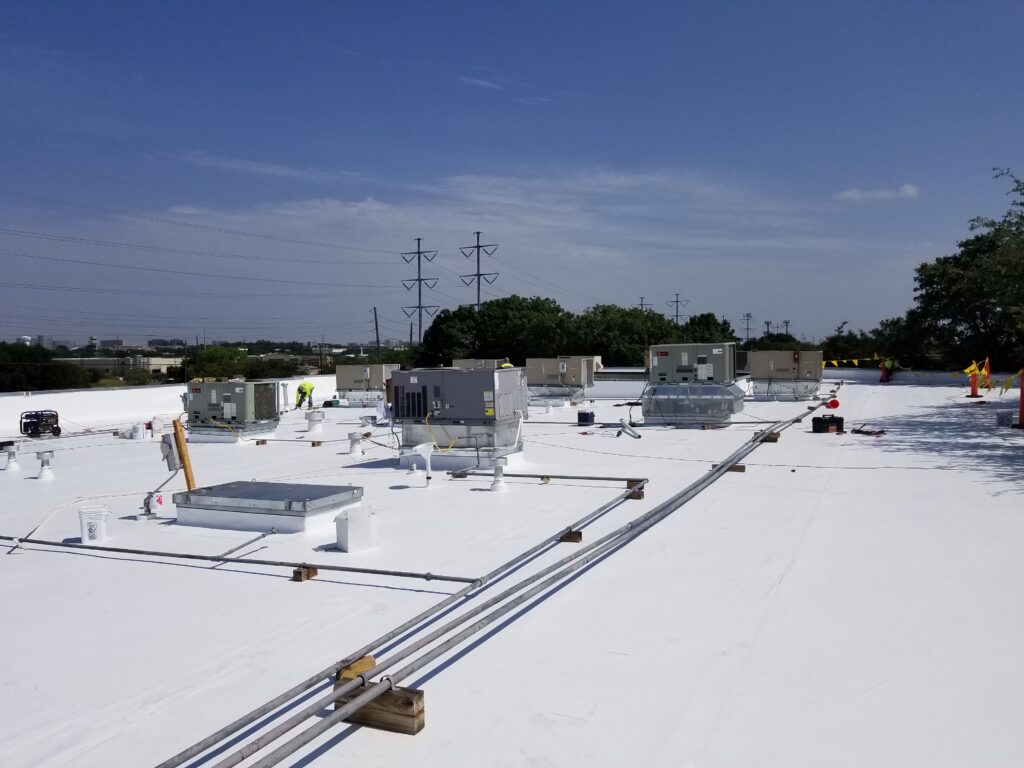
TPO Roof Systems - 60-mil and 80-mil for San Antonio's Heat Load
Roof Systems

TPO Roof Systems - 60-mil and 80-mil for San Antonio's Heat Load

TPO 60-mil and 80-mil roof systems for San Antonio commercial buildings - mechanically attached, fully adhered, 20-year NDL manufacturer warranty, engineered for 100°F+ summer surface temps.

Scope Type
Roof Systems
Location
San Antonio, TX
Status
Scheduling Roof Walks
Focus
Deck type, insulation, attachment, drainage, warranty path, and heat exposure.

San Antonio summer surface temperatures on dark membranes regularly hit 165°F or higher. That kind of thermal loading degrades insulation faster, stresses seam welds, and shortens membrane service life on any system that absorbs rather than reflects solar radiation. TPO - thermoplastic polyolefin - was engineered to solve that problem. The white surface reflects roughly 80% of incoming solar radiation. The result is a substrate that runs 50 to 70°F cooler than dark modified bitumen or BUR on the same building, which is measurable in reduced HVAC runtime during July and August.

Commercial Roofers of San Antonio installs TPO systems on new construction, recover-over-existing, and full tear-off replacements across the metro. The buildings we have worked on range from the USAA Babcock Road campus on the Northwest Side and the large distribution facilities along the IH-, to the hospitality buildings along the Riverwalk corridor downtown and the medical office buildings clustered around the South Texas Medical Center on Fredericksburg Road. The system specifications vary by building use, wind exposure, and warranty path - but the installation standard does not.

60-mil vs. 80-mil - Choosing the Right Thickness

60-mil TPO is the baseline commercial specification in San Antonio. It is adequate for most warehouse, retail strip center, and office buildings with standard rooftop traffic. Every major manufacturer - GAF EverGuard, Carlisle Sure-Weld, Johns Manville, Sika Sarnafil, Versico - offers a 20-year NDL warranty on 60-mil installed to specification. Most of the large-format commercial buildings built in the Stone Oak and US-281 corridor through the 2000s are running 60-mil systems.

80-mil TPO makes sense when rooftop mechanical access is frequent, when the building is a hospital, data center, or manufacturing facility with maintenance personnel crossing the roof repeatedly, or when the capital horizon justifies the incremental cost of a 25-year warranty path. The thicker membrane resists puncture better, handles foot traffic and equipment dragging more forgivingly, and reduces the likelihood of the kind of incidental damage that voids warranties on 60-mil systems in heavy-traffic environments.

Both thicknesses are available in white, light gray, and tan. White is the standard recommendation for San Antonio given the heat load. Buildings that need to meet ASHRAE 90.1 or Texas IECC energy compliance often require the reflectance and emittance values that only a white membrane delivers - cool-roof compliance is a function of both metrics, and gray or tan TPO may not

Mechanically Attached vs. Fully Adhered

Mechanically attached is the production standard for most San Antonio commercial work. The membrane is fastened through the insulation into the deck on a screw-and-plate pattern designed against ASCE 7-22 wind-uplift calculations for the building's location, height, and exposure category. It installs faster than adhered systems, costs less per square foot, and is the standard specification for the large-footprint warehouse and distribution buildings along IH-35 South and IH-10 West where speed and cost per square matters.

Fully adhered systems bond the membrane directly to the substrate using a compatible adhesive. The result is a cleaner finished surface with no visible fastener rows under the membrane, better performance in extreme uplift scenarios, and a system that works on substrates where additional mechanical penetrations would compromise the deck. Adhered systems are more common on the Pearl District mixed-use buildings and the downtown Riverwalk hotel roofs where architectural finish quality and minimal visual texture matter. They cost more and install more slowly, but the finished surface is cleaner and the uplift resistance is higher.

Our fastener pattern is never generic. For mechanically attached systems, we calculate the field zone, perimeter zone, and corner zone uplift requirements separately for each building using the actual building geometry, height, and terrain exposure. Corner zones near the parapet edges on San Antonio high-rises downtown can require fastener density two to three times higher than the field zone. We document the design calculation in the project closeout package.

Common Failure Modes in San Antonio and How We Prevent Them

Cold-weld seam failures are the most common TPO defect across San Antonio's commercial inventory. A weld that was not at temperature during installation looks complete but has no molecular bond. It fails within two to five years. Our welders run test welds at the start of every production day and again after any extended break. We probe-test every linear foot of every seam with a round-tipped probe before closeout - any failed probe location gets cut out and rewelded, not patched.

Flashing failures at penetrations, parapets, and drains account for most active leaks on San Antonio roofs that have intact field membranes. We follow each manufacturer's published flashing detail exactly - no improvised details that vary from the specification. Every flashing is photographed against the spec drawing at closeout and included in the warranty documentation package.

Ponding water is a structural and membrane issue on many San Antonio flat roofs. The limestone-influenced low slopes and aging drain systems on buildings from the 1980s and 1990s create ponding zones that stress seams and accelerate UV degradation in the ponded areas. We identify ponding zones during inspection and design tapered insulation packages that drain them - or flag the ponding explicitly in the scope document if eliminating it is not feasible within the project budget.

Frequently asked questions

How long does 60-mil TPO last in San Antonio's heat?

Modern 60-mil TPO formulations from major manufacturers are designed for 20-year service under the UV and thermal loading of Climate Zone 2. With documented annual maintenance that keeps the manufacturer warranty active, actual service life in San Antonio regularly runs 25 to 30 years before reflectivity degradation or seam wear requires significant intervention.

Can my building use TPO as a recover over the existing roof?

Possibly. A recover is the right path when existing insulation core samples come back dry, when the deck is sound, and when the existing membrane profile is low enough that the recover assembly stays within the manufacturer's thickness limits. We pull moisture cores in representative locations before recommending recover over tear-off. A recover over wet insulation voids the new warranty and traps moisture that accelerates deck degradation - it is not a shortcut we take.

Which TPO manufacturer do you prefer for San Antonio buildings?

We install systems from GAF, Carlisle, Johns Manville, Sika Sarnafil, and Versico. The right manufacturer depends on the warranty terms, the building owner's existing roof asset standard, and manufacturer field-rep coverage in the San Antonio metro. We are manufacturer-agnostic and will document the basis of the recommendation so the owner understands the tradeoffs.

What does an NDL warranty actually cover?

A no-dollar-limit warranty means the manufacturer covers both labor and materials for qualifying defects over the warranty term - not just materials. Labor costs are a significant part of any roof repair, so an NDL warranty is substantially more valuable than a materials-only warranty. The NDL warranty requires that the roof be installed by a manufacturer-approved contractor and that documented annual maintenance be performed. We build the first-year maintenance inspection into the project closeout package.

Scoping a TPO system for a San Antonio building?

Our project managers will walk the roof, document existing conditions, and produce a TPO scope - replacement or recover - with manufacturer warranty path and installed-cost estimate.

Request a Roof Scope

Need TPO Roof Systems - 60-mil and 80-mil for San Antonio's Heat Load?