
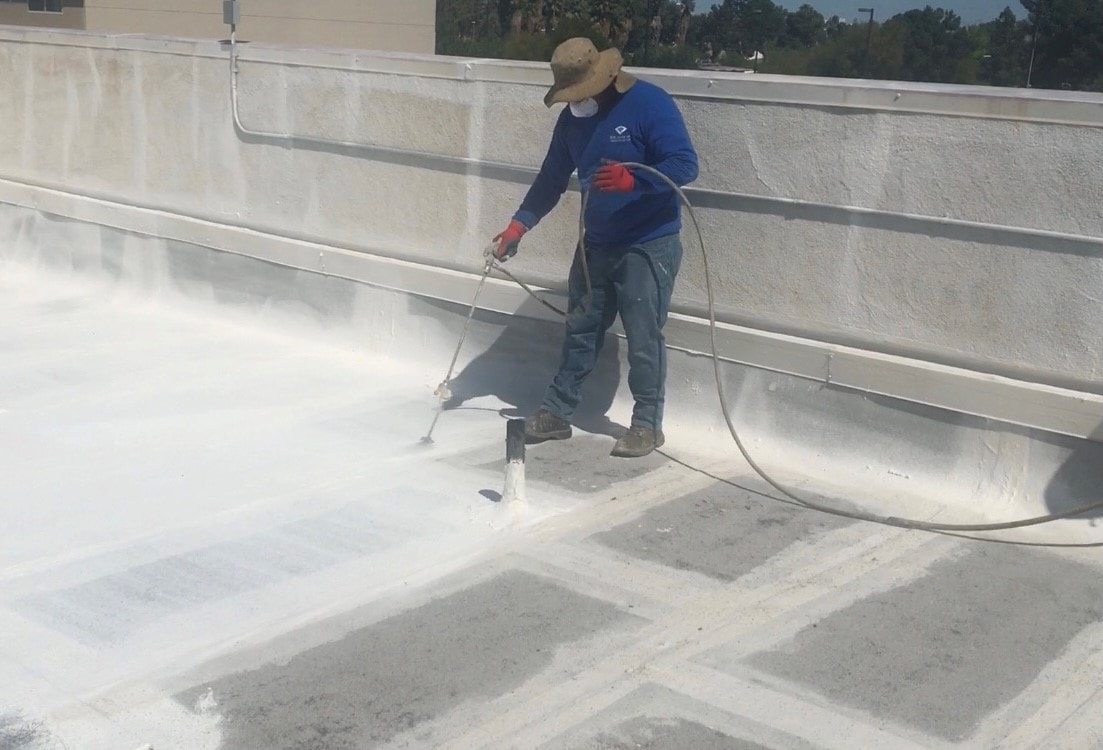
San Antonio's summer heat load is among the most severe in commercial roofing. July and August surface temperatures on dark commercial membranes in this market regularly reach 165°F - the kind of heat that accelerates membrane oxidation, stresses seam welds, and drives cooling energy costs that building operators feel every month. A properly applied silicone fluid coating reflects 80 to 85 percent of incident solar radiation and can reduce rooftop surface temperature by 50 to 70°F, measurably reducing HVAC load on the buildings below.
We install silicone fluid-applied coatings on qualifying TPO, EPDM, modified bitumen, and metal roofs. The qualifying step is what separates a coating project from a failed coating project. We pull moisture cores on every job before we quote. Coating over wet or saturated insulation traps moisture in the substrate and produces a blistering, delaminating coating within two to three years - a waste of the owner's money and a liability for us. If the substrate does not qualify for coating, we say so and provide a replacement scope.
Why Silicone for San Antonio's Climate
Silicone is the coating chemistry best suited to San Antonio's extremes. It remains flexible from below freezing through 300°F surface temperatures - a range that covers everything from the Uri freeze of February 2021 to a late-July afternoon at the AT&T Center on the East Side. Acrylic coatings, by contrast, soften and flow under sustained high-temperature ponded water, which is exactly the condition that San Antonio's blocked-drain flat roofs create.
Silicone is also hydrophobic after cure - water beads off the surface rather than being absorbed. On San Antonio roofs where low-slope geometry creates short-duration ponding after heavy rainfall, silicone's resistance to ponding water is a material advantage over acrylic-based systems. Ponded water on an acrylic coating washes out the film; ponded water on a cured silicone coating does not.
We specify silicone from GE Enduris, Tremco AlphaGuard, or Coating Products International in the formulation and thickness required to achieve the manufacturer's 20-year warranty. The specification includes the primer coat, the base coat at minimum 20 mils dry film thickness, and the finish coat with granule embed where the manufacturer requires it. We document wet-mil thickness readings at regular intervals across the roof to verify compliance.
Substrate Assessment and Preparation
Moisture core pulls are the first step on every potential coating project. We pull cores at five to ten representative locations - more on large roofs or roofs with a history of reported leaks. If more than 15 percent of the core locations read wet by gravimetric test, we disqualify the roof from coating and provide a replacement scope. If the wet area is limited and localized, we can scope a targeted insulation replacement at the wet zones, seal those areas, and proceed with coating on the remaining qualifying area.
Surface preparation drives coating adhesion. On TPO and EPDM, we clean the membrane with a manufacturer-specified cleaner, abrade or scuff the surface to promote adhesion, and apply a primer compatible with both the membrane and the coating. On modified bitumen, we clean, prime, and fill any surface voids and blisters before the coating goes down. On metal roofs, we wire-brush rust, clean with a solvent wipe, and prime with a rust-inhibiting primer before the silicone base coat.
All seams, flashings, and penetrations are reinforced before the base coat. We embed polyester fabric reinforcement in the base coat at all seam laps, parapet-to-field transitions, and penetration details. This reinforcement is what separates a coating that lasts 20 years from one that fails at the details in three. We photograph every reinforcement location against a schematic before the finish coat goes down.
Warranty Path and the Cool-Roof Credit
A properly executed silicone coating project with a qualifying substrate carries a 20-year manufacturer warranty - the same term as a new TPO or EPDM membrane on a replacement project. The warranty requires documented annual maintenance, which we structure into a maintenance contract at closeout. Coatings that lapse their maintenance requirement lose the warranty; we track maintenance cycles for every coating project we close.
The reflectivity of a white silicone coating - typically 0.82 initial solar reflectance index (SRI) - qualifies for the cool-roof credit under San Antonio's current energy code. For buildings in the HEB corporate campus supply chain, the USAA insurance campus buildings on Babcock Road, and the Brooks City Base commercial development, the cool-roof documentation we produce at closeout can support LEED or ENERGY STAR credits relevant to the owner's reporting obligations.
We also document the coating's thermal performance in the owner's building operations record. A before-and-after rooftop temperature comparison - taken with an infrared thermometer on a clear summer afternoon before and after coating application - is the most direct evidence of the coating's thermal impact. We do this on every project where the owner wants the data.
Frequently asked questions
How do I know if my San Antonio commercial roof qualifies for a coating?
The primary qualifier is insulation dryness. We pull moisture cores at five to ten locations across the roof. If less than 15 percent of the core locations read wet, the roof is a candidate for coating - subject to membrane surface condition and flashing integrity. The secondary qualifier is membrane age and condition: a TPO roof with widespread seam failures or membrane oxidation through the thickness needs replacement, not coating. We will tell you which path applies to your building.
What is the cost comparison between coating and replacement on a typical San Antonio commercial roof?
On a qualifying roof, silicone coating runs approximately 40 to 55 percent of the cost of a full TPO or EPDM replacement at current San Antonio material and labor rates. The tradeoff is that coating extends the useful life of the existing system by 20 years, while replacement resets the clock on a new 20- to 25-year system. Both paths carry a 20-year manufacturer warranty when properly executed. The right answer depends on the substrate condition, the building's capital horizon, and the owner's operating budget.
Can a silicone coating be applied over existing coating?
It depends on the existing coating type and condition. Silicone can be re-coated with silicone at the 10- to 15-year mark - this is one of the genuine lifecycle advantages of the silicone chemistry. Silicone cannot be reliably coated over an acrylic or urethane system without stripping the existing coating first. We test adhesion with a peel test before proceeding on any re-coat project.
How long does a roof coating project take on a typical San Antonio commercial building?
For a 20,000 sq ft building with a qualifying substrate and straightforward flashing details: two to three days of production. Substrate prep and primer application are day one, base coat with reinforcement at all details is day two, and finish coat is day three. We do not apply silicone coating when ambient temperatures are below 40°F or above 100°F - San Antonio's summer schedule shifts to early-morning application to stay within the application temperature window.
Find out if your San Antonio commercial roof qualifies for coating.
We walk the roof, pull moisture cores, and produce a written assessment - qualifying substrate, estimated scope, and 20-year warranty path - before any work begins.
Request a Roof Scope