
Modified Bitumen Roofing in San Antonio
Roofing Services

Modified Bitumen Roofing in San Antonio

Modified bitumen roofing for San Antonio's downtown and Westside commercial stock - torch-applied, self-adhered, and recover decisions on legacy BUR buildings near UTSA Downtown and the historic Westside.

Scope Type
Roofing Services
Location
San Antonio, TX
Status
Scheduling Roof Walks
Focus
Repair history, moisture risk, roof access, system condition, and replacement timing.

Modified bitumen is a bitumen-based membrane reinforced with polyester or fiberglass mat - the successor technology to built-up roofing (BUR). The downtown San Antonio commercial inventory, the Westside masonry buildings near the historic districts, and the mid-century institutional buildings around the UTSA Downtown campus at 501 W Cesar Chavez carry decades of modified bitumen and BUR history. Many of these buildings have been reroofed two or three times - each cycle adding a recover layer over the previous system, with the original BUR still somewhere in the assembly.

We execute torch-applied and self-adhered modified bitumen installations, and we navigate the recover decisions on these layered-history buildings with straightforward analysis. The question is always: how many layers are currently on the deck, what is the total weight, and what does the deck's dead-load capacity allow? When the answer is that the deck cannot support another recover layer, the scope is tear-off and replacement - with the weight history documented for the permit application.

Torch-Applied vs. Self-Adhered Modified Bitumen

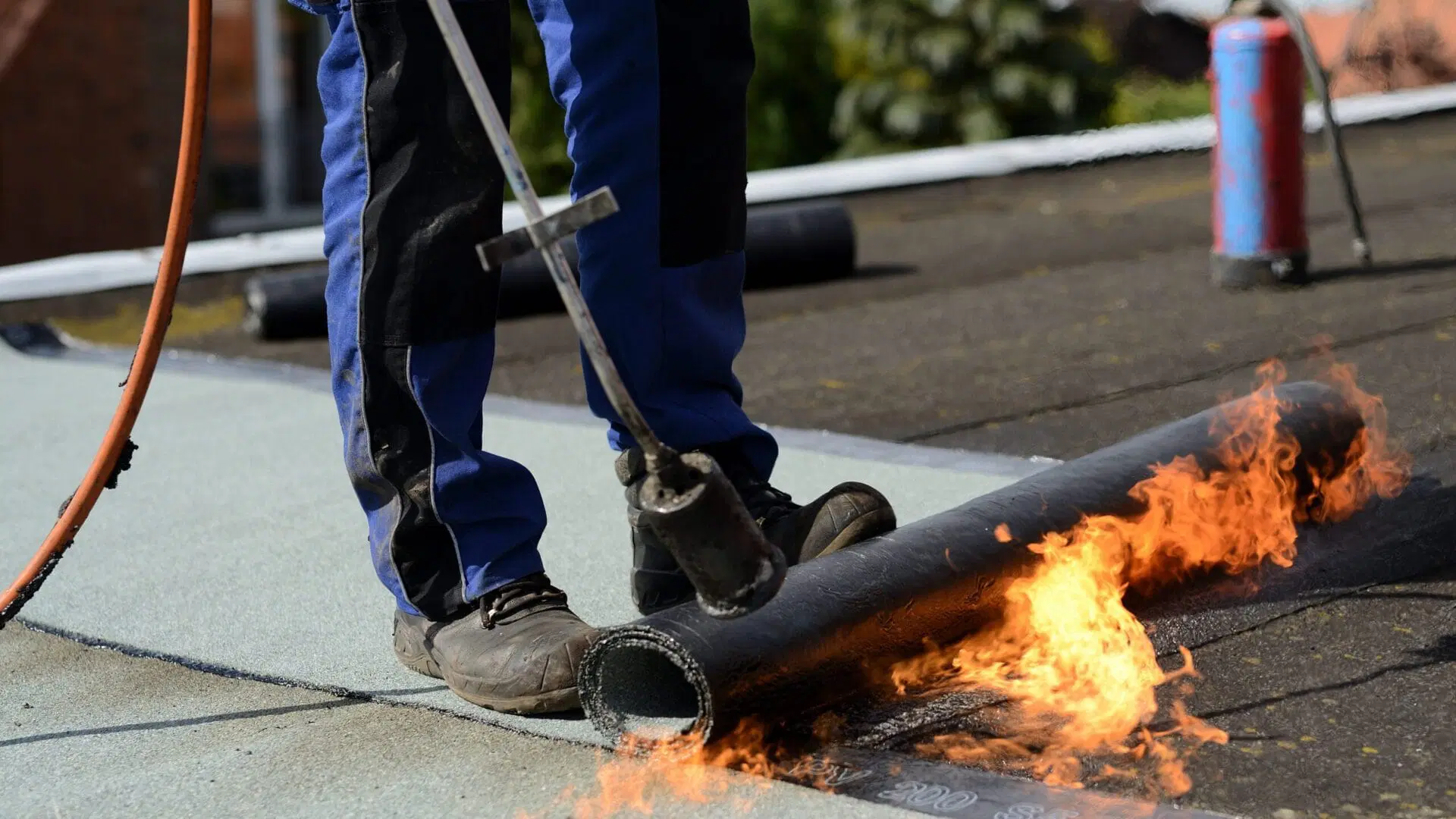
Torch-applied modified bitumen is the traditional method and produces the most reliable seam weld on SBS (styrene-butadiene-styrene) modified bitumen cap sheets. The torch heats the bitumen backer until it flows, bonding the cap sheet to the base sheet and the base sheet to the substrate. When properly executed, torch-applied seams are homogeneous with the membrane and do not delaminate. Torch application requires a hot-work permit in San Antonio for most commercial buildings - we coordinate the permit with the City of San Antonio Fire Department before mobilizing.

Self-adhered modified bitumen eliminates the open-flame requirement and is the appropriate method for occupied buildings where torch application is not feasible - hospital roofs, occupied retail buildings, schools - and for buildings in historic districts where open flame introduces preservation risk. The tradeoff is that self-adhered seams are more application-temperature-sensitive. Below 50°F, the adhesive does not bond reliably; above 95°F substrate temperature, the adhesive can flow out of the lap. San Antonio's summer heat schedule shifts self-adhered application to early-morning production.

APP (atactic polypropylene) modified bitumen is a third formulation more common in cold climates - it is torch-applied but has different thermal characteristics than SBS. We see APP on some San Antonio buildings originally specified by out-of-market contractors who defaulted to APP. For repairs and recovers on APP systems, we match the chemistry at the perimeter and detail work.

Recover Decisions on San Antonio's Layered BUR and Mod-Bit Inventory

The buildings near the UTSA Downtown campus, the Westside commercial corridor along Guadalupe Street, and the older retail and office buildings between downtown and the Medical Center carry the most complex layering histories in San Antonio's commercial roof inventory. We have opened up roofs on these buildings and found four-ply BUR under two layers of modified bitumen - a combined assembly that can exceed 20 lbs per square foot before the existing insulation weight is added.

The IBC structural limit for dead load on a commercial low-slope roof is the starting point for the recover analysis. For steel deck buildings - which describes most of the post-1960 commercial construction in the area - the deck manufacturer's dead-load rating is the controlling number. If the existing assembly is already at or near that limit, a recover layer is not permitted without a structural engineering review. We flag this condition at the inspection and refer to a structural engineer when it applies.

When a full tear-off is required, modified bitumen is still a legitimate replacement specification on downtown and Westside buildings where the substrate geometry - complex penetration patterns, multiple drainage levels, tight parapet dimensions - favors a bitumen-based system over a single-ply membrane. Mod-bit conforms to complex geometry more readily than single-ply, and it does not require the same seam-width discipline that TPO and EPDM demand at irregular penetrations.

Modified Bitumen on Historic and Character-Defining Buildings

Several of the buildings near Alamo Plaza, along Commerce Street, and in the Mission district of the historic Westside are designated historic properties or are in historic overlay districts. For these buildings, the roof system is rarely the preservation issue - the low-slope flat roof is not visible from street level - but the work access, debris management, and crane staging often require coordination with the City of San Antonio Office of Historic Preservation.

On buildings with slate or clay tile mansard sections adjacent to the flat-roof area, we coordinate the flat-roof scope to avoid damage to the visible historic roofing. Modified bitumen terminations at the base of tile sections are among the most common failure points on these mixed-geometry buildings, and we detail them with flexible counterflashing rather than rigid metal, which can crack the tile mortar bed during thermal cycling.

Hot-work permits near historic masonry require additional precautions. We run torch-applied work with a fire watch on-site for two hours after completion - longer than the standard municipal requirement - when working near historic wood structure or preserved interior elements.

Frequently asked questions

How do I know if my San Antonio building can support another modified bitumen recover layer?

We pull a small core through the existing assembly to count the layers and estimate the total assembly weight. We compare that to the deck's rated dead-load capacity - available from the building's structural drawings, or estimated from the deck type and span if drawings are not available. If the existing assembly is within the capacity limit for an additional recover layer, we document that in writing. If it is not, we produce a tear-off scope with the weight-history documentation for the permit application.

Is torch-applied modified bitumen allowed in downtown San Antonio?

Yes, with a hot-work permit from the San Antonio Fire Department. The permit process is routine - we have pulled hot-work permits for torch-applied mod-bit work on multiple downtown and Medical Center-adjacent buildings. The permit requires a fire watch during application and for a specified period afterward. We build the fire watch requirement into the production schedule.

How long does modified bitumen last in San Antonio?

A properly installed two-ply SBS modified bitumen system with granule-surface cap sheet typically lasts 15 to 25 years in San Antonio conditions. The granule surface protects the bitumen from UV degradation. When granule loss becomes visible - typically after 10 to 15 years - the cap sheet is approaching the end of its UV-resistance cycle and the decision is whether to coat (extend with a reflective coating) or recover. We assess the granule loss and oxidation depth during inspection and give a numeric estimate of remaining useful life.

Can modified bitumen be coated to extend its life?

Yes. A granule-surface SBS modified bitumen cap sheet with intact granulation and no membrane cracking is a candidate for a silicone or aluminum-fiber coating that can extend useful life by 5 to 10 years. We assess granulation and oxidation depth before recommending coating - a cracked or deeply oxidized cap sheet should be replaced, not coated.

Scoping a modified bitumen project on a San Antonio legacy building?

We assess the existing assembly, make the recover-versus-replace call based on factual deck-load analysis, and produce a written scope with installed costs before any work begins.

Request a Roof Scope

Need Modified Bitumen Roofing in San Antonio?