
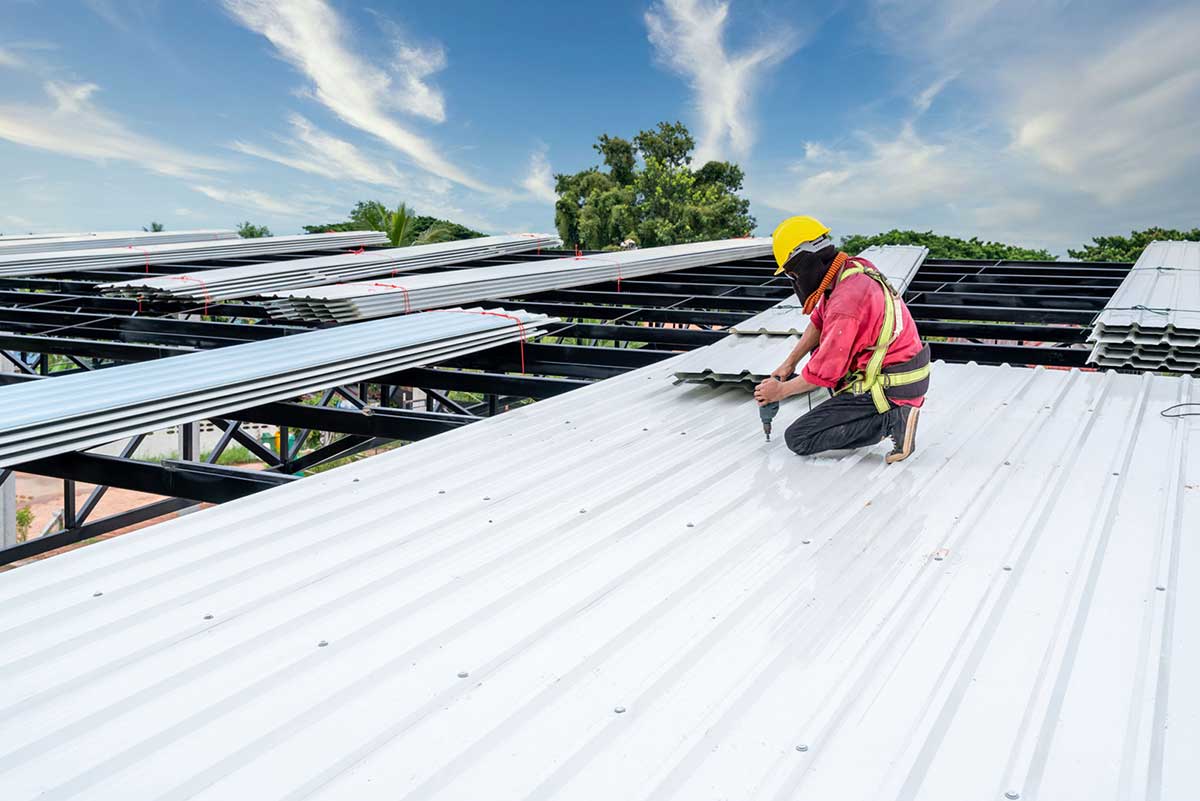
The recover-versus-replace decision is the most consequential scoping question on any aging San Antonio commercial flat roof. Get it right and the building owner either saves 40 to 50 percent of replacement capital (if recover qualifies) or avoids installing a warranted membrane over wet insulation that would void the warranty and fail within three to five years (if it does not). Get it wrong in either direction and the cost is real money.
San Antonio's commercial roof inventory is well into its second and third reroof cycles on the oldest stock. The downtown institutional and hospitality buildings built in the 1970s and 1980s - hotels along the Riverwalk, office towers near the Alamodome, the convention center district buildings - are now on second or third reroof cycles. The suburban office and industrial buildout of the 1990s along US-281, Loop 1604, and the IH-35 corridors is now approaching the 20 to 25-year mark, which is the recover decision window for well-maintained single-ply systems. The more recent construction near Brooks City Base on the Southeast Side and the Pearl District is still in its first maintenance cycle - too young to think about recover, but the right buildings to establish a documented baseline for the capital decision that will come.
We have no financial incentive to push replacement over recover or recover over replacement. A recover project on a 100,000 square foot San Antonio warehouse might run $7 to $10 per square foot installed, versus $13 to $16 per square foot for full replacement. If recover is the honest scope, we scope it. If the insulation is wet, we scope replacement - because covering wet insulation does not dry it out.
Moisture Core Sampling Protocol
We pull moisture cores at a density of one per 4,000 to 5,000 square feet on roofs being considered for recover - a minimum of six cores on any roof we evaluate regardless of size. Core locations are chosen to sample all roof zones: field areas, locations near drains, areas near reported or suspected leak points, and zones with visible surface anomalies such as blisters, delamination, or prior patch repairs. On a 50,000 square foot single-story San Antonio commercial building, that is 10 to 12 core pulls during the inspection visit.
Each core cut is inspected visually - wet insulation changes color from white to yellow or brown in polyiso, and shows obvious saturation in fiber insulation - and weighed before and after oven-drying to quantify moisture content where field assessment is ambiguous. Core locations are marked on the roof zone diagram and each core's finding is documented. The written report shows the core location map, the finding at each location, and the percentage of core locations reading wet.
Our threshold: if more than 25 percent of core locations show wet insulation, recover is not the honest scope. Wet insulation does not dry out under a new membrane - it continues to deteriorate, supports biological growth in the assembly, and degrades the new membrane's adhesion over time. It also voids the manufacturer's warranty at the first warranty inspection. Below 25 percent wet cores, targeted insulation replacement at wet zones combined with a recover membrane produces a warranted system with full expected service life.
One San Antonio-specific complication: the February 2021 Uri freeze event produced moisture infiltration into roof assemblies across the city as pipes failed and ice-dammed drainage sent water laterally through building envelopes. Several commercial buildings in the Medical Center corridor and the Stone Oak office parks show moisture in their insulation assemblies that pre-dates any visible membrane failure - originating from the Uri event rather than membrane degradation. We ask about the building's post-Uri history during the inspection and treat any building that experienced Uri-related interior damage as a higher-risk candidate for wet insulation regardless of surface appearance.
Recover System Design for San Antonio Climate
A recover system has three components: the attachment method to the existing roof, the new insulation overlay, and the new membrane. Each is specified based on the existing roof's condition, the San Antonio climate's wind and UV requirements, and the manufacturer's recovery system design package.
Attachment: most recover systems on San Antonio commercial buildings are mechanically attached - screws and plates driven through the new insulation, the existing membrane, and the existing insulation into the deck. The fastener pattern is designed to the building's wind-uplift requirement using ASCE 7-22 wind pressure calculations for the building's location, height, and exposure category. San Antonio is generally Exposure B to C depending on terrain and adjacent buildings - open-exposure buildings on the Northwest Side or along the IH-10 West corridor toward Boerne receive more conservative fastener density.
Insulation overlay: typically a minimum 1-inch polyiso cover board or a thicker rigid polyiso layer, depending on the energy code compliance gap. IECC 2021 for Climate Zone 2 requires R-25 on new low-slope assemblies. If the existing insulation contributes R-15 and is dry, the recover system's insulation layer must close the gap to R-25. We calculate the existing-plus-new R-value and identify the minimum overlay thickness needed for code compliance before finalizing the recover scope.
Membrane: TPO, EPDM, modified bitumen, or silicone coating, selected and specified the same way as a new replacement system. San Antonio's heat load makes white reflective TPO the default recommendation on most recover projects - the surface temperature reduction of 50 to 70°F versus a dark membrane meaningfully reduces the UV stress on the new membrane and extends its expected service life. The recover membrane carries the same 15 to 20-year manufacturer warranty as a new installation if the substrate passes the manufacturer's recover system requirements.
When Recover Makes - and Does Not Make - Sense
Recover makes sense when: insulation is dry at more than 75 percent of core locations, the deck is sound under every core pull, the existing membrane has no active open seams or delamination in the field area, and the building has not already had a recover layer installed over the original roof system. On a San Antonio commercial building meeting all four conditions, a recover system at $7 to $10 per square foot installed versus $13 to $16 per square foot for replacement delivers 40 to 50 percent capital savings with equivalent warranty protection.
Recover does not make sense when: wet core percentage exceeds 25 percent, the existing roof already has a prior recover layer installed (code requires full tear-off before another recover can be applied), the deck has structural deterioration at any core pull location, or the existing membrane is so degraded that it cannot provide a uniform substrate for the recovery system's fastener attachment.
Texas building code following IBC limits commercial flat roofs to one recover layer over the original roof system before tear-off is required. San Antonio's older commercial stock - particularly the pre-2000 downtown and Medical Center buildings - sometimes has a recover from the mid-2000s that owners and property managers do not have documentation for. We identify prior recover layers during core investigation (the core shows two membrane layers) and document the layer count in every written recover assessment. Finding a second membrane layer after a scope has been awarded is a project-stopping problem - we surface that finding during inspection.
Frequently asked questions
How much does a San Antonio commercial roof recover system cost versus full replacement?
A recover system on a qualifying San Antonio commercial flat roof typically runs $7 to $10 per square foot installed, compared to $13 to $16 per square foot for a full tear-off replacement on the same building. The savings come primarily from eliminating tear-off and disposal costs and reusing the dry existing insulation. The savings are only real if the recover scope is honest - a recover over wet insulation fails its warranty and costs the full replacement price again within three to five years.
How do you patch the core holes after the inspection?
We replace the core plug in the hole and seal it with compatible peel-and-stick flashing tape - the same material used for membrane repairs. The repair is watertight and leaves no permanent damage to the membrane. We photograph each patched core as part of the inspection documentation so there is a before-and-after record.
Can I recover a building that already had one recover layer installed?
No - Texas building code limits commercial flat roofs to one recover layer over the original roof system. If a prior recover layer exists, the next scope is a full tear-off to deck. We identify prior recover layers during core investigation and include that finding in the written report before any contract is signed.
Recover or replace - need a clear answer for your San Antonio building?
We will pull moisture cores, document the results, and give you a written recover-vs-replace recommendation with system options and installed cost estimates for both paths.
Request a Roof Scope