
Infrared Moisture Scanning for Commercial Roofs
Roofing Services

Infrared Moisture Scanning for Commercial Roofs

Infrared thermography moisture surveys for San Antonio commercial flat roofs - non-destructive wet insulation mapping, insurance-grade documentation, and core sample confirmation.

Scope Type
Roofing Services
Location
San Antonio, TX
Status
Scheduling Roof Walks
Focus
Repair history, moisture risk, roof access, system condition, and replacement timing.

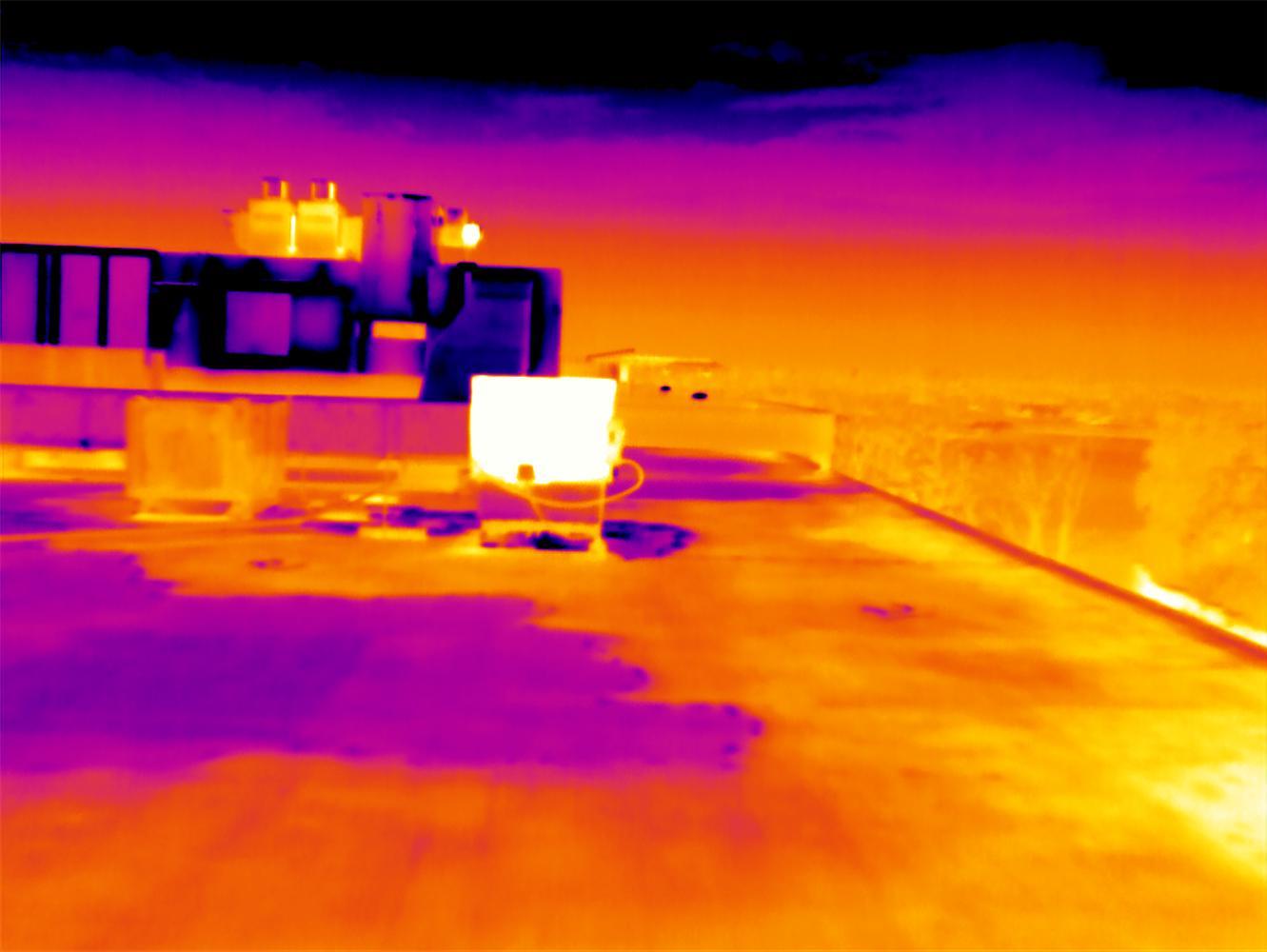
Wet insulation hidden under an intact membrane is one of the most expensive conditions in commercial roofing because it is invisible until the membrane fails, the insulation compresses under foot traffic, or the moisture migrates into the deck. By then, the damage has often spread far beyond the original entry point. Infrared moisture scanning locates wet insulation non-destructively - we map the full roof surface and produce a moisture map showing where the insulation is dry, suspect, and confirmed wet, before a single fastener is removed.

The physics of IR scanning depends on differential thermal mass. During the day, the sun loads the roof surface. After sunset, dry insulation releases stored heat quickly while wet insulation - which has higher thermal mass - releases heat slowly. From the roof surface, a calibrated infrared camera shows the wet areas as warm anomalies against the cooling dry field. San Antonio's cooling pattern after sundown in the fall and winter months - typically a 20 to 30°F drop from midday peak - is well-suited to IR scanning. We schedule scans from approximately one hour after sunset through midnight during these months to capture the clearest thermal differential.

We use IR scanning as a pre-scope tool on every roof where recover-versus-replace is an open question, and on any building where an insurance claim requires documentation of the extent of storm or freeze damage. The scan does not replace core sampling - we confirm anomalies with targeted cores - but it directs the cores to the right locations instead of guessing.

When IR Scanning Works in San Antonio - and When It Does Not

Optimal conditions in San Antonio: The fall and winter months - October through February - provide the best scanning conditions. Daytime temperatures need to reach at least 90°F and nighttime temperatures need to drop at least 15 to 20°F below the daytime high to create the thermal differential that makes wet insulation visible. San Antonio's October through February weather pattern delivers those differentials reliably. Spring scanning is possible but less reliable - the smaller diurnal temperature swings in March through May reduce the thermal differential and increase the number of inconclusive anomalies.

When IR scanning does not work: Cloudy days prevent the solar loading that charges the roof surface. Scanning within 24 hours of significant rainfall is unreliable because surface moisture produces anomalies independent of insulation condition - the scan cannot distinguish wet membrane surface from wet insulation. Very high wind also degrades scan quality by cooling the surface differentially. We will reschedule a scan if conditions are not suitable rather than deliver an unreliable result.

Ballasted roofs and metal deck buildings: Ballasted membrane systems - gravel or pavers over EPDM - block the IR signal because the ballast layer has its own thermal mass. We do not scan ballasted roofs. Metal deck buildings with thin insulation may show interference from the deck's thermal signature. We assess suitability before scheduling and will advise if a building is not a good IR candidate.

How We Conduct the Scan and Confirm Findings

Pre-scan walk: We walk the roof in daylight to mark drain locations, equipment positions, and any visible membrane damage. This gives us a base map for the IR overlay and flags areas where surface damage might produce thermal anomalies independent of moisture.

Nighttime scan: One technician walks the roof in a grid pattern with a calibrated FLIR thermal camera. A second technician monitors the image stream from the roof access point for scan quality and marks anomaly locations in real time. The scan covers the full roof surface - we do not sample.

Core confirmation: Every anomaly that reads as probable wet insulation gets a core pull the following morning. We bore a 3-inch diameter core through the membrane and insulation layers, inspect the insulation for visible moisture or discoloration, and measure moisture content with a moisture meter. Cores that confirm wet insulation are retained, photographed, and documented in the report. The core hole is patched same-day.

Moisture map deliverable: The final report overlays the IR anomaly map on the roof zone diagram, marks confirmed wet areas from core sampling, and calculates the percentage of the roof with confirmed wet insulation. This number drives the recover-versus-replace recommendation: under 25% confirmed wet areas generally supports a targeted repair plus recover; above 25% generally supports full replacement, because recovering over extensive wet insulation voids the new system warranty.

Uses for IR Scan Data in San Antonio

Recover-versus-replace decisions: The most common use. An owner facing a reroof decision on a 20-year-old TPO system needs to know whether the insulation is reusable. A full-roof IR scan with core confirmation answers that question more accurately than any visual inspection and at a fraction of the cost of unnecessary tear-off.

Insurance claim documentation: After a major hail event or freeze, insurance adjusters require documentation of pre-existing versus storm-caused damage. An IR scan conducted immediately after the event and before any repairs creates a defensible moisture map that establishes the storm's contribution to insulation saturation. We have produced IR scan reports for buildings across Bexar County following the February 2021 Uri freeze and the 2023 hail events in the Stone Oak and Boerne corridor.

Capital planning: Building owners and asset managers who manage multi-building portfolios use IR scans to prioritize reroof capital across the portfolio. Scanning three or four buildings in a single night produces a moisture-condition ranking that lets capital allocation decisions be made on data rather than assumptions about membrane age alone.

Warranty claim support: Some manufacturer warranty programs require IR scan documentation to process claims involving alleged membrane defects. We format the scan report to

Frequently asked questions

How much does an infrared roof scan cost for a San Antonio commercial building?

Scan cost scales with roof area and the number of core confirmations needed. As a general range: a 20,000 to 50,000 sq ft building runs roughly $800 to $1,800 for the scan, plus $50 to $75 per core pull and patch for confirmation cores. For a building where the scan drives a replace-versus-recover decision on a 200,000 sq ft reroof, the scan cost is a small fraction of the decision it informs. We provide a fixed-price quote before scheduling.

Will you cut holes in my roof to confirm the scan findings?

We pull targeted 3-inch cores only to confirm IR anomalies that read as probable wet insulation - not at every scan location. A typical scan on a 30,000 sq ft roof results in 4 to 8 confirmation cores. Each core hole is patched same-day with a compatible membrane material and the patch is sealed and photographed. The roof is watertight before we leave the site.

Can you do an IR scan in the summer in San Antonio?

Summer scanning is possible but less reliable because San Antonio's summer nights rarely cool below 85°F - the temperature drop from daytime high to nighttime low is smaller, which reduces the thermal differential that makes wet insulation visible. We can attempt summer scans if timing is critical for a business decision, but we will be explicit about the limitations in the report. We recommend scheduling scans from October through February when conditions are most favorable.

Map the moisture in your San Antonio commercial roof before you commit to a scope.

We schedule IR scans during the optimal fall and winter window and deliver a written moisture map with core-confirmed findings - the right input for a reroof decision or an insurance claim.

Request a Roof Scope

Need Infrared Moisture Scanning for Commercial Roofs?