
Infrared Roof Scanning - When It Works in San Antonio and When It Doesn't
Capabilities

Infrared Roof Scanning - When It Works in San Antonio and When It Doesn't

IR thermography for San Antonio commercial roofs - understanding when infrared scanning is a useful diagnostic tool in SA's climate and when it isn't, and what the data actually shows.

Scope Type
Capabilities
Location
San Antonio, TX
Status
Scheduling Roof Walks
Focus
Photos, written findings, priority ranking, budget timing, and owner-ready documentation.

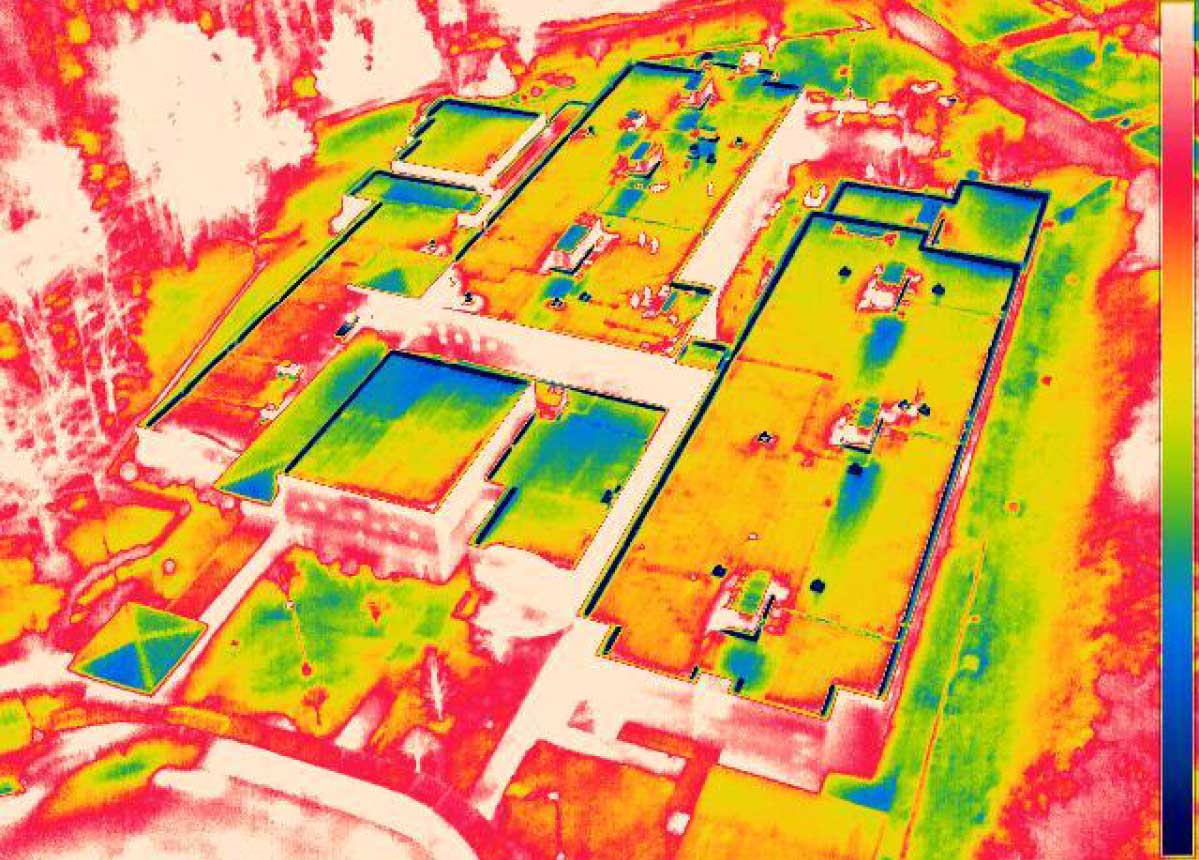
Infrared (IR) thermography for commercial roofs works on a straightforward physical principle: wet insulation retains daytime heat longer than dry insulation. When the roof surface cools after sunset, the areas over wet insulation stay warmer - they appear as warm spots in an IR image taken during the early nighttime cooling window. That thermal signature allows an IR scan to map moisture distribution across a large roof surface faster than core sampling alone.

The limitation is that the thermal differential between wet and dry insulation is only visible when the ambient temperature drops enough at night relative to the daytime heat load. In San Antonio, that temperature differential is significant from October through February. During the July and August peak heat months, nighttime temperatures regularly stay above 80°F, and the entire roof surface retains heat at roughly similar levels - wet and dry insulation are nearly indistinguishable in the thermal image. Trying to do IR scanning in August in San Antonio produces data that is difficult to interpret and easy to misread.

At Commercial Roofers of San Antonio, I use infrared scanning as a tool within the appropriate seasonal window and in combination with core sampling for verification. IR is not a replacement for core sampling - it is a prioritization tool that helps us place core samples in the most informative locations on large roof surfaces. Understanding what IR can and cannot show is the service.

The San Antonio IR Window - October Through February

The optimal IR scanning window for San Antonio commercial roofs runs from mid-October through late February. During these months, the temperature differential between daytime peak (typically 65°F to 80°F) and the evening hours (45°F to 60°F) is large enough to produce readable thermal contrast between wet and dry insulation. The scan is conducted one to three hours after sunset, during the active cooling phase when the differential between retained heat over wet insulation and ambient-cooled dry insulation is at its maximum.

March through May is a transitional window. Early spring can produce readable IR data on cool nights, but nighttime temperatures become less reliable as the season progresses. A scan attempted in May in San Antonio might produce excellent data on a cool night following a cold front, and uninterpretable data on a warm night two days later.

June through September is not a reliable IR scanning window for San Antonio. Nighttime temperatures above 78°F collapse the thermal differential, and the daytime heat load on San Antonio rooftops during these months - surface temperatures reaching 160°F to 170°F on dark membranes - means the entire roof substrate holds heat into the evening at levels that obscure the moisture signature.

This seasonal constraint matters for project sequencing. If a building owner in San Antonio needs a moisture survey before a spring construction window, the IR scan window for that purpose closed in February. Core sampling can be done year-round and does not have this seasonal constraint - which is why core sampling is the primary moisture assessment protocol for San Antonio roofs, with IR as a supplement.

What Infrared Scanning Shows - and What It Doesn't

IR scanning shows: moisture distribution patterns in insulation, relative to the thermal differential at the time of the scan. A warm spot in a nighttime IR image of a San Antonio commercial roof during the October-February window is a high-confidence indicator of elevated moisture content in the insulation below.

IR scanning does not show: the membrane surface condition, the deck condition, the insulation thickness, the character of the deficiency that allowed the moisture to enter, or the saturation percentage at any specific location. A warm spot on the IR image tells us where to put a core sample - it does not replace the core sample.

IR scanning can produce false positives from: rooftop equipment heat radiating into the insulation layer beneath the equipment, utility conduit runs through the insulation, thermal bridging at metal deck ribs, and reflective interference from adjacent building surfaces or rooftop equipment. A skilled IR technician reads these artifacts out of the image - an unskilled interpretation treats them as moisture indications and produces a misleading saturation map.

For San Antonio's commercial inventory specifically: buildings with metal deck and mechanically attached TPO show thermal bridging at the fastener plates that can be misread as moisture indication by operators who are not familiar with the signature. We document the deck type and attachment method before the scan and account for the expected thermal pattern in the interpretation.

IR Scan Protocol - How We Conduct and Interpret the Data

Scan timing: One to two hours after sunset during the active cooling phase. We verify that the roof surface is dry before beginning - a recent rain event will wet the membrane surface and produce thermal patterns from surface moisture rather than insulation moisture, which are indistinguishable in the image without context. We require at least 48 hours of dry weather before a scan intended to map insulation moisture.

Equipment: A calibrated thermal imaging camera with sensitivity adequate for the expected differential. For San Antonio winter conditions, the differential between wet and dry insulation is typically 2°F to 6°F at the optimal scan window - which requires a camera with at least 0.1°C NETD sensitivity to image reliably.

Output: The IR scan produces a thermal image set of the full roof surface, annotated with zone references from the roof diagram. Warm areas are flagged and mapped to the zone diagram. The annotated thermal map is included in the moisture survey report alongside the core sample results. For each warm area in the IR image, we document whether a core sample confirms moisture, which validates the IR interpretation and provides the saturation characterization the IR image alone cannot provide.

Frequently asked questions

Can you do an IR scan in the summer in San Antonio?

Technically yes, but the data quality is unreliable. San Antonio's summer nighttime temperatures above 78°F produce insufficient thermal differential between wet and dry insulation for confident interpretation. We do not recommend scheduling IR scanning from June through September for San Antonio buildings - the cost of the scan is not justified by the data quality. Core sampling is a better protocol for summer moisture assessment.

How does an IR scan compare to core sampling in cost and accuracy?

IR scanning covers a large roof area quickly - a 100,000 sq ft roof can be scanned in two to four hours. Core sampling covers a small number of discrete locations in more time per location. IR scanning is a better tool for identifying where the moisture problem is on a large roof; core sampling is a better tool for confirming saturation at a specific location and evaluating the deck condition. The most accurate moisture assessment combines both - IR to prioritize core locations, cores to confirm the IR findings.

Does the IR scan need to happen at night?

Yes. Daytime IR scanning on San Antonio commercial roofs is not a reliable moisture assessment protocol. The daytime solar load heats the entire roof surface and masks the thermal differential between wet and dry insulation. Some contractors offer daytime IR scanning and describe it as a moisture survey - the results are not reliable and should not be used for recover-versus-replace decisions. Nighttime scanning, during the post-sunset cooling phase, is the protocol that produces interpretable data.

Need an IR scan scheduled in San Antonio's optimal window?

We schedule IR scanning from October through February for San Antonio commercial buildings and combine IR findings with core sampling for a complete moisture assessment.

Request a Roof Scope

Need Infrared Roof Scanning - When It Works in San Antonio and When It Doesn't?