
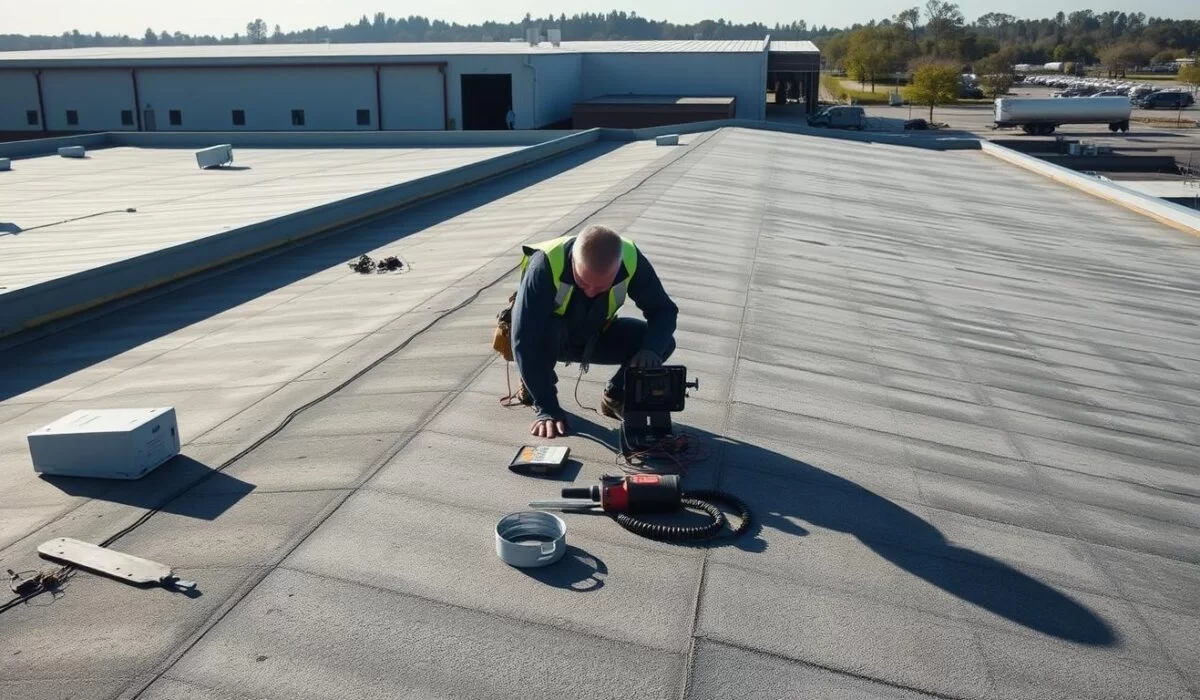
Every major commercial roof manufacturer - GAF, Carlisle, Johns Manville, Sika Sarnafil, Versico - issues NDL (no-dollar-limit) warranties on their commercial membrane systems. These warranties are substantial: 20 years on 60-mil TPO and EPDM, 25 years on some PVC systems, with coverage for both material defects and workmanship on manufacturer-authorized installations. For a San Antonio building owner, a valid 20-year NDL warranty is a real asset - it supports insurance negotiations, lease negotiations, and the building's value in a sale.
The problem is that these warranties carry maintenance requirements that most building owners do not actively manage. Annual documented inspections by a manufacturer-authorized contractor. Prompt repair of deficiencies identified during inspection. Documented approval for any rooftop work - equipment installations, penetrations, conduit runs - performed after the initial installation. Missing any of these requirements does not trigger a formal warranty cancellation notice. The warranty just becomes unenforceable. Most owners discover this at the worst possible moment: when they need to file a claim.
Warranty coordination is the discipline of actively managing those maintenance requirements across the full warranty term. I track the maintenance obligations for every warranted roof in the buildings I manage - which manufacturer issued the warranty, what the maintenance schedule requires, when each obligation is due, and what documentation each manufacturer accepts as proof of compliance. The warranty stays current because someone is watching it.
Manufacturer Requirements - What Each One Actually Expects
GAF (EverGuard TPO, EPDM, PVC): Requires annual inspection by a Roofing Contractor. The inspection must be documented on GAF's inspection form or an equivalent record that captures the inspection date, inspector credentials, deficiencies found, and corrective action taken or planned. GAF's NDL warranty (EverGuard Advantage) is their premium tier - it requires both annual inspection documentation and prompt repair of identified deficiencies within a defined timeframe.
Carlisle (Sure-Flex TPO, EPDM, PVC): Carlisle's Platinum warranty tier requires annual inspection documentation and a Carlisle-approved contractor for all repair and maintenance work. Carlisle is explicit that rooftop penetrations made after the original installation require Carlisle-approved flashing details - a conduit penetration done by an electrical contractor without proper roofing coordination can create a documented warranty gap.
Johns Manville (TPO, EPDM, ISO): JM's NDL warranty requires documented semi-annual inspections at their highest coverage tier. For buildings on JM warranties in San Antonio, this means a spring inspection (post-freeze window, February-March) and a fall inspection (post-summer, September-October) - which happens to align with the rational inspection calendar for San Antonio's climate.
Sika Sarnafil and Versico: Both require annual inspection documentation and manufacturer-approved repair contractors. Sika has a formal Roofcare program that integrates maintenance documentation into the warranty record. Versico's requirements are similar to Carlisle's. For both manufacturers, we track the documentation requirements directly with the manufacturer's regional representative - requirements can vary by warranty tier and by .
The Documentation Discipline - What We Produce and When
For each warranted building in our management program, we maintain a warranty file that contains: the original warranty document, the manufacturer approval letter for the installing contractor, the close-out inspection report from the installation, and a chronological log of every subsequent inspection and repair.
The inspection cycle produces the annual or semi-annual inspection record in the format each manufacturer accepts. Deficiencies identified during inspection are logged and their repair status is tracked - not closed out of the file until the repair is documented as complete. The repair record includes the repair date, the scope of work, the materials used (with manufacturer part numbers), and a photograph of the completed repair.
Any rooftop work that occurs between inspection cycles - equipment installations, utility penetrations, HVAC replacements - is coordinated through the warranty file. Before any non-roofing contractor works on or near the roof, we document the planned penetration or modification and confirm with the manufacturer's representative that the proposed detail is warranty-compliant. This prevents the common situation where an HVAC contractor cuts a new return air penetration with a non-standard detail that voids the section of the warranty covering that roof zone.
When a Warranty Claim Becomes Necessary
If a San Antonio building experiences a roofing failure that falls within the manufacturer's warranty coverage - a membrane defect, a seam weld failure from an installation error, an insulation performance failure - the claim process requires the documentation record we have been maintaining. The manufacturer's claim inspector will review the inspection history, the repair records, and the maintenance log.
A complete documentation file does two things: it supports the claim by demonstrating that the owner fulfilled their maintenance obligations, and it localizes the deficiency to a specific zone with specific photographs so the manufacturer's inspector can verify the claim scope efficiently. Claims supported by complete documentation close faster and recover more of the repair cost than claims submitted without supporting records.
We have supported warranty claim processes with GAF, Carlisle, and JM for San Antonio buildings in our management program. The claims process is slower than most owners expect - two to four months from claim submission to approved repair authorization is typical - but a well-documented claim gets through the process with fewer supplemental information requests.
Frequently asked questions
Can you coordinate warranty maintenance on a roof that was installed by another contractor?
Yes, provided we can verify that the original installation was completed by a manufacturer-authorized contractor and that the warranty was properly registered at installation closeout. We request the original warranty document and the installation close-out package. If the documentation is incomplete, we contact the manufacturer's regional representative to verify the warranty status before we take over the maintenance obligation.
What if the warranty has already lapsed?
A lapsed warranty cannot be retroactively reinstated in most cases. But the condition of the roof can be documented accurately, and that documentation has value for capital planning even without the manufacturer warranty behind it. In some cases - where the roof is in good condition but the maintenance records lapsed due to an ownership change - manufacturers have agreed to reinstate warranty coverage with a paid inspection and a written remediation plan. We have facilitated this process with Carlisle and GAF in San Antonio. It is not guaranteed, but it is worth attempting before accepting that the warranty is gone.
Does warranty coordination work for buildings that have multiple manufacturers on different roof sections?
Yes. It is not uncommon for a large San Antonio commercial building to carry a GAF warranty on one roof section and a Carlisle warranty on another - particularly if sections were replaced in different years by different contractors. We track each manufacturer's requirements separately and maintain separate warranty files for each section. The inspection report is organized by zone, so each section's inspection record satisfies the applicable manufacturer's requirement.
Find out if your San Antonio roof warranty is still active.
We will review the warranty documentation, verify the maintenance record, and identify any gaps before your next inspection cycle - so the warranty is enforceable when you need it.
Request a Roof Scope