
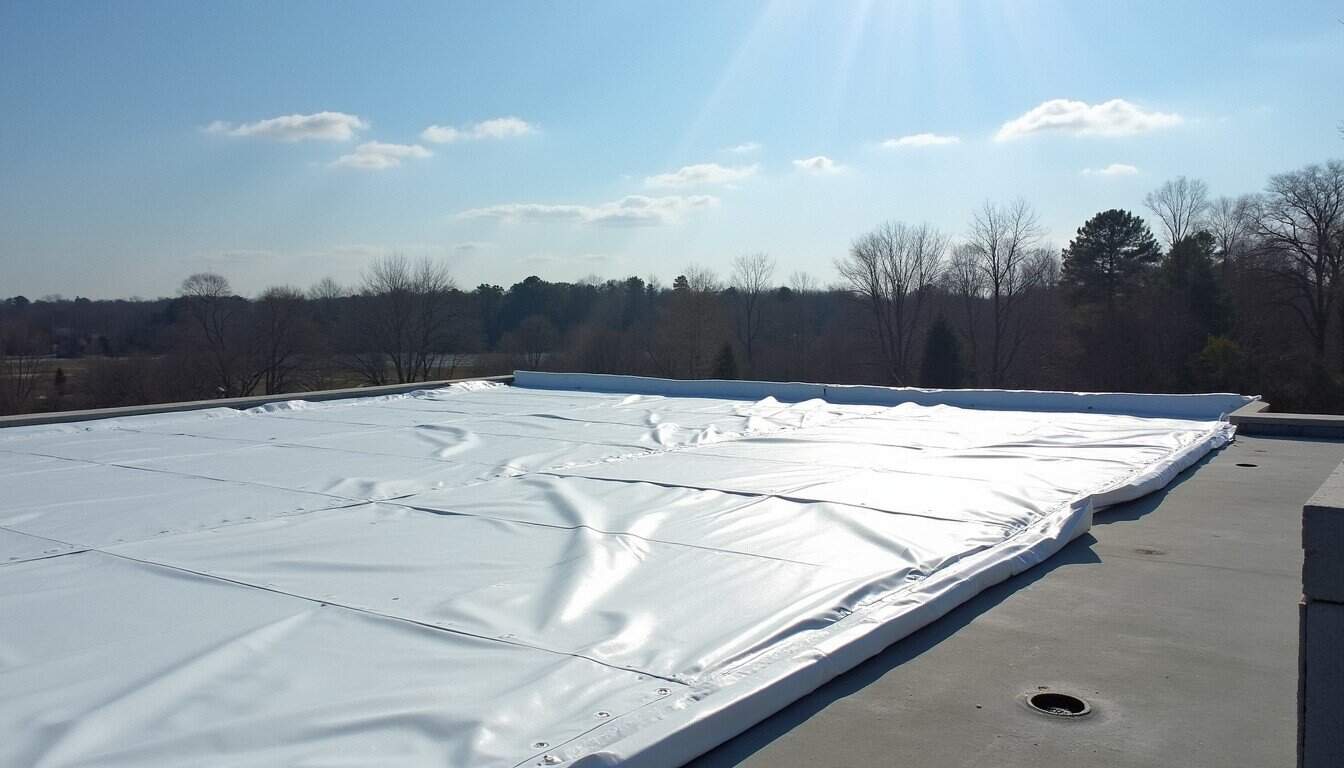
San Antonio doesn't take direct hurricane landfall, but the metro sees plenty of wind that can damage a commercial roof. Spring and summer bring severe thunderstorm cells that build over the Hill Country and push through the I-10 and 281 corridors, sometimes producing straight-line wind gusts strong enough to lift edge metal or peel back a membrane field. Isolated microburst events — sudden, localized downdrafts that can concentrate damaging wind on a single block while leaving the surrounding area untouched — show up most summers. Gulf-system remnants also track inland through South Texas after making landfall on the coast, arriving in San Antonio as sustained wind and heavy rain rather than a direct hurricane hit, but still capable of producing real roof damage on a building already carrying wear.
Wind failure on a low-slope commercial roof almost always starts at an edge — loose edge metal, deteriorated parapet coping, or a field seam that was already marginal before the wind event tested it. Once wind gets under the edge, it can propagate a membrane failure across a much wider area than the initial failure point, which is why documenting exactly where a wind failure started, and how far it traveled, matters for scoping the repair correctly rather than just patching the visible tear.
The building stock affected by wind damage varies across the metro. Downtown and Riverwalk-adjacent commercial buildings — mid-rise office and hospitality stock with more complex roof geometry, parapets, and mechanical penthouses — see wind exposure concentrated at corners and mechanical curbs where wind loading is highest. Big-box retail and warehouse buildings along Loop 410, I-35, and the northside business parks carry large, open low-slope membrane fields where a single edge-metal failure can propagate across a significant run of roof before it's discovered from the inside as a leak.
Documentation for a wind claim centers on the uplift failure pattern: where the membrane or edge metal failed first, how the failure propagated, and why the observed pattern is consistent with a wind event rather than ordinary seam aging. We reference the building's wind exposure category and design wind speed in the written narrative, because that context is what lets an adjuster evaluate whether the observed damage is consistent with an event that exceeded the roof assembly's design load — an explanation that's often missing from contractor-written wind damage estimates.
Microburst damage has a distinctive signature worth documenting on its own: concentrated, severe damage on one building or one section of a roof with little or no damage on neighboring structures. That localized pattern is itself useful evidence, because it corresponds to how microburst downdrafts actually behave, and it helps rule out the alternative explanation that the damage was gradual, pre-existing wear rather than a single event.
We're your roofing contractor, not a public adjuster — we document and substantiate the wind and storm damage so you and your adjuster work from an accurate, defensible scope.
Questions Owners Ask
What's the difference between straight-line wind damage and a microburst?
Straight-line wind comes from a broader thunderstorm system and tends to affect a wider area fairly uniformly. A microburst is a sudden, concentrated downdraft that can produce severe, localized damage on one building or one block while leaving nearby roofs essentially untouched. Both can cause real roof damage; the documentation approach differs because a microburst's damage pattern is itself part of the evidence that a distinct wind event occurred.
Does my roof need to show total membrane loss to file a wind claim?
No. Many legitimate wind claims involve edge-metal displacement, a lifted seam, or localized membrane tearing rather than total loss. What matters for the claim is documenting the failure mechanism and connecting it to a wind event, not the total square footage affected.
Can Gulf storm remnants cause insurable wind damage this far inland?
Yes. San Antonio regularly receives the remnant wind and rain from Gulf coast systems days after landfall. These events can bring sustained wind well above what a roof sees on an ordinary day, and damage from them is generally treated the same as damage from any other wind event for insurance purposes, subject to the specific policy language.
What wind speed typically triggers a covered claim?
There's no universal threshold — it depends on the policy's wind/hail deductible structure and cause-of-loss definitions, as well as the roof assembly's design wind rating and condition before the event. A roof already near the end of its service life can show wind damage at speeds a newer, well-maintained roof would tolerate without issue. We document the physical evidence; interpreting it against your specific policy terms is a conversation for your broker or adjuster.
How do you document wind uplift versus aging or installation issues?
We trace the failure back to its likely starting point — typically an edge, seam, or penetration — and document the propagation pattern, the condition of the fasteners or adhesive at the failure point, and whether the failure is consistent with a sudden load event versus gradual deterioration. That written analysis, paired with the photo evidence, is what gives an adjuster a basis for the determination.
Explore More
- Commercial Roof Insurance Claim Assistance
- Hail Damage Roof Insurance Claims
- Wind Damage Roof Repair
- Insurance Claim Roof Documentation
- Commercial Roof Inspections
- Contact
- Commercial Roof Repair
- Commercial Roof Replacement
- Commercial Roof Coatings
- Roof Maintenance Programs
- Commercial Roof Inspections & Reports
- Roof Reports & Assessments