
San Antonio sits close enough to the southern edge of Texas Hail Alley that commercial roofs across Bexar County take a hail hit most storm seasons, usually in the spring and early-summer window when Hill Country storm cells build and track southeast toward the metro. Some seasons are quiet across the northside; others put damaging hail down on the Stone Oak and 281 corridor, the Boerne belt along I-10 West, or the business parks off Loop 1604 in the same afternoon. The pattern is hyper-local — one roof takes a direct hit while a building three blocks away shows nothing — which is exactly why generic, undocumented hail claims run into trouble with carriers.
What hail does to a commercial roof depends heavily on the membrane. On TPO and PVC single-ply, hail impacts typically appear as a spatter or bruising pattern — circular marks where the impact stressed the membrane without necessarily puncturing it, which insurers will scrutinize closely because the damage isn't always a visible hole. On modified bitumen surfaces, hail knocks loose the granule surfacing, exposing the asphalt cap sheet underneath to accelerated UV degradation. On older built-up roofing, hail impacts can fracture the gravel ballast layer and bruise the felt plies beneath it. Metal copings, rooftop HVAC cabinets, and skylight domes take visible dents and cracks that are useful corroborating evidence even when the low-slope membrane itself shows only subtle marking.
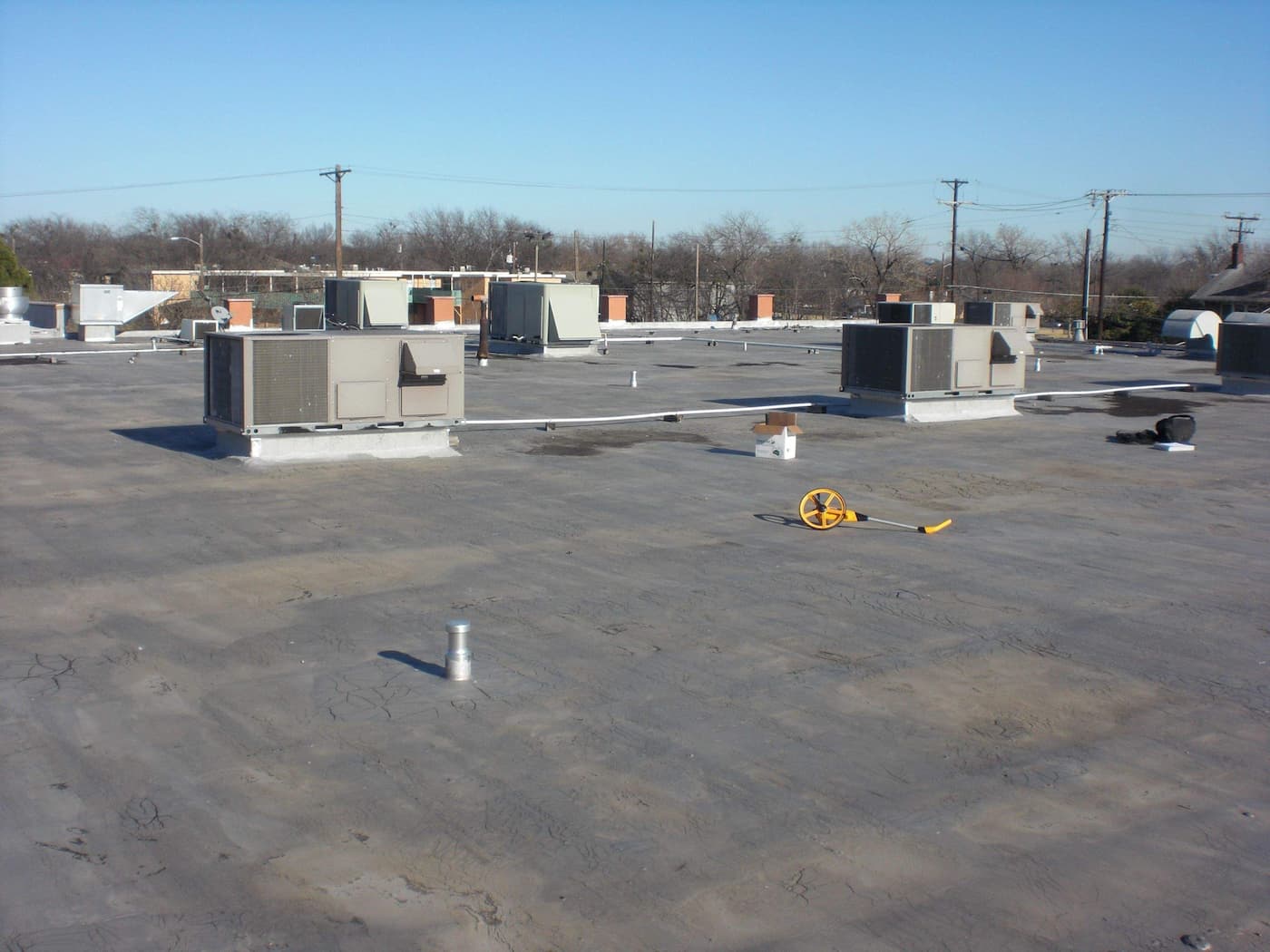
San Antonio's low-slope commercial roof stock — the business park buildings along Blanco Road and the 281 corridor, the big-box retail centers along Loop 410 and I-35, and the large flat-roof distribution and warehouse buildings on the south and east sides — presents a documentation challenge simply because of scale. A 150,000-square-foot warehouse roof can take a hail event across its entire surface, and mapping impact density by zone is the only way to give an adjuster a defensible picture of how widespread the damage actually is, rather than a handful of photos from the areas easiest to reach.
Hail claims run into a specific kind of pushback from carriers: the argument that visible marking is cosmetic rather than functional damage, and doesn't warrant a covered repair or replacement. That argument is harder to sustain against a documentation package that maps impact density across the roof, correlates the pattern to a reported hail event for the date in question, and explains — membrane by membrane — why the marking observed represents a loss of the membrane's protective capability rather than surface cosmetics. Impact-fractured cover board and compromised seam integrity under an intact-looking membrane surface are common findings that don't show up without a documented inspection.
Our hail inspection produces a photo log keyed to a roof zone diagram, an impact density map, membrane-specific damage notes, and a written scope that an adjuster can work from without a second site visit. When the adjuster schedules the roof walk, we're there to walk the same documentation with them.
We're your roofing contractor, not a public adjuster — we document and substantiate the hail damage so you and your adjuster work from an accurate, defensible scope.
Questions Owners Ask
Is hail damage on a commercial roof always visible from the ground?
No. On a low-slope commercial roof, hail impacts are usually only visible from the roof surface itself, and even there the marking can be subtle on light-colored TPO or PVC membrane. Ground-level indicators like dented gutters, cracked skylight domes, or damaged rooftop equipment can suggest a hail event occurred, but they don't tell you the extent of membrane-level damage. A roof-level inspection is the only reliable way to know.
Does cosmetic hail damage count for an insurance claim?
It depends on the policy and the carrier's assessment of whether the marking represents actual loss of function versus appearance only. This is one of the most contested points in hail claims. Documentation that maps impact density, identifies membrane-specific damage mechanisms, and distinguishes functional impact from surface marking gives your adjuster the basis to evaluate the claim on the facts rather than a blanket cosmetic determination.
How soon after a hailstorm should I get my roof inspected?
As soon as reasonably possible. Hail-compromised membrane and cracked seams don't always leak immediately — sometimes it takes a subsequent rain event to find the weak point — so early documentation captures the damage before it's masked by a later, unrelated cause. It also puts a timestamped record on file close to the event date, which strengthens the connection between the storm and the damage.
What roof systems in San Antonio are most vulnerable to hail?
Aged EPDM and older built-up roofing tend to show the most severe hail response because the membrane or ballast layer is already brittle from UV and thermal cycling. Newer TPO and PVC systems generally hold up better against smaller hail but can still take functional damage from larger stones, particularly at seams, penetrations, and flashing details.
Will my insurer dispute hail damage as pre-existing wear?
It's a common carrier response, especially on older roofs. The strongest counter is documentation that separates event-related damage from pre-existing conditions with photographs and a written explanation of the basis for each classification — rather than a single lump description of everything found on the roof.
Explore More
- Commercial Roof Insurance Claim Assistance
- Wind & Storm Damage Roof Insurance Claims
- Hail Damage Roof Repair
- Insurance Claim Roof Documentation
- Commercial Roof Inspections
- Contact
- Commercial Roof Repair
- Commercial Roof Replacement
- Commercial Roof Coatings
- Roof Maintenance Programs
- Commercial Roof Inspections & Reports
- Roof Reports & Assessments