
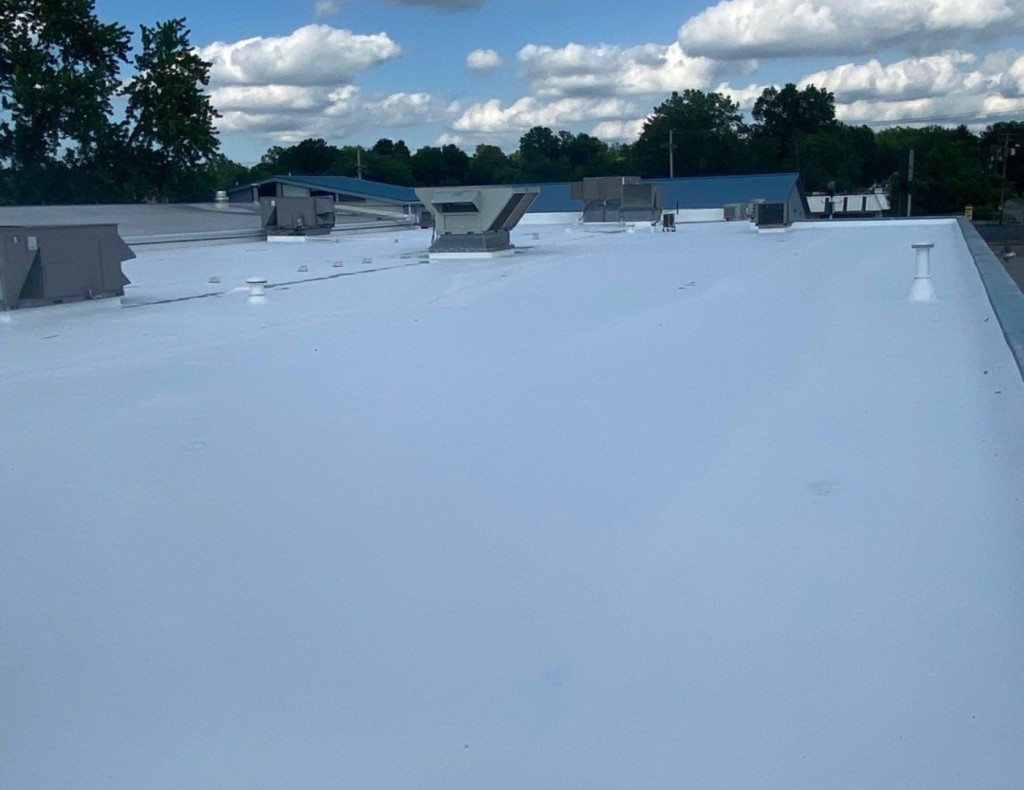
Single-ply roofing dominates new commercial construction in San Antonio. From the large-format distribution centers along the IH- to the mid-rise office buildings in the Stone Oak US-281 corridor and the mixed-use developments in the Brooks City Base redevelopment on the Southeast Side, single-ply is the system that goes on most commercial flat roofs built in this market over the past 25 years.
What changes from building to building is not which single-ply membrane to use - that is driven by building use, chemical exposure, and owner preference - but how to attach it. Mechanically attached, fully adhered, ballasted, and hybrid attachment methods each have performance characteristics and cost profiles that make them appropriate or inappropriate for a given San Antonio building. We make the attachment-method decision based on the building's ASCE 7-22 wind exposure classification, the deck type, the insulation system, and the manufacturer's warranty requirements.
Wind Exposure Classification in San Antonio - Mostly B, with C Exceptions
ASCE 7-22 defines three main exposure categories for wind-uplift design: Exposure B (suburban terrain with buildings, trees, and obstructions), Exposure C (open terrain with scattered obstructions), and Exposure D (coastal zones). San Antonio is predominantly Exposure B - the urban density, suburban development patterns, and topographic screening provided by the Hill Country ridges to the northwest reduce wind speed at roof level relative to open-terrain conditions.
Exposure C conditions apply at specific locations across the metro. Buildings along the IH-35 North corridor from Live Oak through Schertz toward New Braunfels sit in a broader open-terrain zone where northerly wind events accelerate. The industrial buildings on the far western side of San Antonio - along Potranco Road and the Culebra Road corridor toward Helotes - are similarly exposed. Our wind-uplift calculations for buildings in those zones use Exposure C pressure coefficients, which produce a more conservative fastener density than the same building would require in a downtown location.
The February 2021 Uri freeze produced wind events that caused single-ply membrane blow-off on several San Antonio buildings that were specified to Exposure B but experienced effective Exposure C conditions due to adjacent buildings that had lost their wall cladding in the storm. This was an extreme event, but it reminded us that exposure classification should be conservative when the building is at the edge of the B/C boundary.
Mechanically Attached vs. Fully Adhered - The Core Decision
Mechanically attached (MA) single-ply is the baseline for most San Antonio commercial work. The membrane is fastened with screws and plates through the membrane and insulation into the deck on a pattern designed to resist the calculated wind-uplift pressure at the building's field, perimeter, and corner zones. MA installation is faster and less weather-sensitive than fully adhered, and it is the most common attachment method for the large-footprint warehouse and distribution facilities on the IH-35 corridors.
The tradeoff of MA over FA is billowing - on a windy day, a mechanically attached membrane moves between the fastener points, producing audible flutter and long-term fatigue stress on the fastener plates and the membrane at the plate location. On very large roofs (200,000 sq ft and above), membrane billowing in mechanically attached systems can become an operational nuisance and a long-term fatigue issue. We evaluate roof size, expected wind frequency, and owner sensitivity to sound when advising on the MA-versus-FA decision.
Fully adhered (FA) single-ply bonds the membrane to the substrate continuously. No billowing, no fastener stress concentration, and a cleaner finished surface. The tradeoff is cost - FA installation requires more labor, is more weather-sensitive (adhesive bonding has temperature and humidity constraints), and requires a substrate that can accept adhesive without delamination. For buildings in San Antonio where summer adhesive application needs to happen before the substrate temperature exceeds 90°F - which means a narrow early-morning window - FA projects require tight production scheduling.
Deck Type and Insulation Compatibility
Steel deck is the most common deck type in San Antonio's commercial inventory. Single-ply can be mechanically attached through polyiso insulation directly into steel deck using self-drilling screws and plates. The fastener pattern is designed against the deck's thickness and rib geometry - light-gauge steel deck (22-gauge) requires a different fastener design than standard 20-gauge. We verify deck gauge during inspection before finalizing the fastener specification.
Concrete deck - common in the downtown office buildings, the medical campus buildings adjacent to the Baptist and Methodist Health System facilities, and the older mid-rise hotel structures in the Riverwalk corridor - requires a different attachment approach. Fully adhered over concrete is the standard path, using concrete-compatible adhesive and a cover board to provide a uniform substrate for adhesion. Mechanically attached to concrete requires concrete-screw fasteners with published pull-out values for the specific concrete strength - we specify these from the deck's structural data when available.
Wood deck and gypsum deck - found on the older institutional and retail buildings in San Antonio's downtown and Westside historic districts - have attachment constraints that require specific fastener types and patterns. On these substrates, the fastener pull-out value is the limiting design factor, and fully adhered is often the preferred path when the substrate condition and adhesion test results support it.
Manufacturer Warranty Alignment for Single-Ply Systems
Manufacturer warranties for single-ply systems in San Antonio are available from GAF, Carlisle, Johns Manville, Sika Sarnafil, and Versico. The warranty term - 15, 20, or 25 years - depends on membrane thickness, attachment method, and the manufacturer's program for the specific building type. Fully adhered systems generally qualify for longer warranty terms than mechanically attached on a given membrane thickness.
Warranty inspections at installation are performed by the manufacturer's field representative. We coordinate the warranty inspection scheduling as part of closeout - the inspection must happen before the warranty is issued, and the roof must be in punchlist-complete condition at the time of inspection. We do not close projects until the warranty inspection is passed and the warranty document is in the owner's hands.
Frequently asked questions
Which single-ply membrane is right for my San Antonio commercial building?
TPO for most commercial, retail, office, and warehouse applications - white reflective surface, 20-year warranty, competitive installed cost. EPDM for large-footprint industrial where ballasted installation is cost-effective and reflectivity is not a priority. PVC for food-service, restaurant, brewery, and chemical-exposure buildings where animal fat or chemical resistance is required. We recommend based on building use, exhaust chemistry, deck type, and owner capital horizon - not based on which system we have the most of in stock.
How do I know if my building is Exposure B or Exposure C for wind-uplift design?
We classify wind exposure during the pre-scope inspection based on the building's location, height, terrain features, and adjacent building density. We use the ASCE 7-22 Exposure B/C criteria - not a generic assumption. For buildings in the IH-35 North corridor, the western San Antonio edge, or at the urban fringe near Boerne or Schertz, we err on the conservative side. The exposure classification is documented in the wind-uplift calculation that accompanies the installation specification.
Can single-ply be installed over an existing flat roof in San Antonio?
In many cases, yes. Single-ply recover over existing single-ply (with dry insulation and sound deck) avoids tear-off cost and qualifies for 20-year manufacturer warranties from most major manufacturers. We verify recover eligibility with moisture cores - a recover over wet insulation voids the new warranty. If the existing system is modified bitumen or BUR, the recover path requires a cover board over the existing surface before the single-ply goes down.
What is the permit requirement for single-ply installation in San Antonio?
The City of San Antonio Development Services Department requires a building permit for commercial roof replacements and recovers. We pull the permit, manage the inspection schedule, and obtain the permit closeout before issuing the warranty documentation. For buildings in Leon Valley, Converse, Universal City, or other incorporated municipalities within Bexar County, permits are pulled from the relevant municipal authority. Our project managers handle the permit process for all jurisdictions we work in.
Scoping a single-ply project for a San Antonio commercial building?
We assess the deck type, wind exposure, and building use, specify the right membrane and attachment method, and produce a written scope with manufacturer warranty path and installed cost before any work begins.
Request a Roof Scope